SENSARTE Reversible Grill & Griddle: Stovetop Performance

Introduction: Why Griddle Choice Matters
Selecting the right griddle or grill pan shapes the range of meals achievable on a stovetop and during portable cooking scenarios. The SENSARTE reversible grill and griddle is positioned for cooks who need a multi-function surface that spans flat griddling for pancakes and sandwiches to ribbed grilling for steaks and vegetables. Material construction, heat transfer characteristics, surface area, and coating chemistry determine how evenly foods brown, how much temperature control is available when used across two burners, and how endurance against repeated high-heat use behaves. For shoppers prioritizing portability, easy cleaning, and stovetop compatibility, this two-burner cast-aluminum pan emphasizes lightweight handling and a Swiss ILAG stone nonstick coating. Understanding its 575-degree Fahrenheit ceiling, grease management features, and reversible form factor helps set realistic expectations for searing performance, smoking limitations, and routine maintenance requirements.
Quick Overview
| Feature | Details |
|---|---|
| Grill or smoker type | Reversible grill and griddle pan (stovetop/portable) |
| Fuel type | Designed for gas and electric stovetops; compatible with two-burner outdoor burners |
| Total cooking area | Approx. 19.5 x 10.7 inches (about 208.7 sq in) |
| Temperature range | Maximum listed temperature 575 degrees Fahrenheit |
| Materials and construction | Cast aluminum body with Switzerland ILAG stone nonstick coating; aluminum handles |
| Control system | Manual control via stovetop burners (no built-in temperature controls) |
| Best suited cooking styles | Pan-frying, griddling, stovetop grilling, light searing |
| Intended use cases | Indoor stovetop two-burner use and portable outdoor camping or BBQ over two burners |
| Warranty | Manufacturer warranty not specified in product disclosures |
This specification set translates to a compact, multi-use cooking surface that prioritizes stovetop versatility and ease of cleaning. The moderate surface area accommodates meals for two to four people depending on portion sizes. The cast aluminum base supports rapid heat conduction while the ILAG nonstick surface reduces required oil and simplifies cleanup, but precise temperature control depends on the stove or burner rather than the pan itself.

Cooking Style Suitability: Griddle, Grill, and Smoking Potential
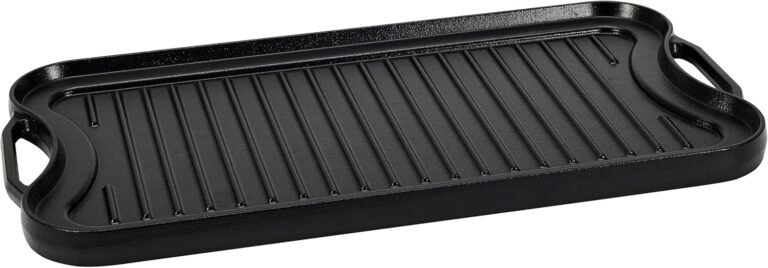
The reversible profile directly targets cooks balancing flat griddle techniques with ribbed grilling needs; the flat side supports quick-contact cooking for pancakes, sandwiches, and eggs while the ribbed side mimics grill marks and allows rendered fats to collect toward the pan’s grease channel. For true low-and-slow smoking, the pan’s open design and stovetop orientation limit sustained smoke capture and airflow control, making it unsuitable as a dedicated smoker. For high-heat searing and medium-temperature griddling, the pan’s cast-aluminum body and stone nonstick support rapid heat transfer and release; flavor development depends on stovetop power, preheating practices, and whether smoke flavor is introduced externally with wood chips on a compatible outdoor burner.

Best foods and techniques for each surface
The flat griddle side excels with foods that require uniform contact and gentle flipping—pancakes, eggs, flatbreads, and pressed sandwiches benefit from the even flat plane. The ribbed side suits steaks, fish fillets, and vegetables where surface caramelization and fat drainage improve texture and sear appearance. Because the pan spans two burners, larger items receive more even heating than single-burner pans. Techniques such as preheating on medium-high, oiling the food instead of the surface when practical, and allowing adequate rest time after high-heat sears support better crust formation and prevent premature coating wear while maintaining nonstick performance.
Limitations for smoking and low-temperature barbecue
The pan’s geometry and stovetop use constrain low-and-slow barbecue techniques that rely on controlled convection, sealed chambers, and prolonged smoke circulation. Without a lid or dedicated chamber, maintaining stable sub-275-degree Fahrenheit zones for several hours is impractical, and smoke retention is minimal. For cooks seeking smoke flavor, combining the pan with outdoor smoking accessories—such as a tray of soaked wood chips on a separate burner or a portable smoker box under an outdoor grate—may add smoke without relying on the pan as the primary smoking vessel. This product is better characterized as a griddle/grill hybrid than a smoker.
Fuel Type Impact: Stovetop and Outdoor Burner Compatibility
The SENSARTE pan is explicitly marketed for gas and electric stovetop use and is noted as portable for outdoor camping BBQ over two burners. Fuel type influences achievable surface temperature, response time, and fuel efficiency; gas burners typically provide rapid response and high peak power beneficial for searing, while electric coil and glass-top elements deliver steadier, slower temperature ramps. When used on portable propane two-burner stoves, the pan benefits from concentrated dual-burner heat distribution but requires attention to burner alignment to minimize hot or cold zones. The pan is not designed as a standalone charcoal or pellet grill; use over open charcoal without an intermediate support is not advised due to direct flame contact and uneven heating characteristics relative to the pan’s aluminum construction.

Performance on gas and electric stovetops
On gas stovetops, the pan can reach higher surface temperatures more quickly, supporting stronger Maillard reactions for searing. The two-burner span allows placement to cover separate heat zones—one side hotter for searing and the other cooler for finishing. Electric stovetops deliver steadier but slower heat increases; thinner cast aluminum heats quickly but may track the slower element response, requiring longer preheat. Glass-top stoves should be managed carefully to avoid scratching and to ensure even burner-to-pan contact. Manufacturer guidance on compatible stovetops should be followed to maintain element integrity and pan stability.
Outdoor fuel options and limitations
The pan’s portability makes it suitable for propane two-burner camping stoves that provide stable flames beneath the full pan footprint, enabling near-stovetop performance outdoors. Charcoal use beneath the pan is limited because direct embers and uneven heat risers can create warping risks and localized overheating of the nonstick coating. Pellet grills and electric pellet systems are incompatible unless the pan sits on a stable, flat surface with indirect heat; however, these setups circumvent the pan’s intended stovetop control scheme. Users seeking grill-surface flavor from wood should employ separate smoking accessories rather than relying on the pan to generate and contain smoke.
Temperature Range and Control Precision
The manufacturer lists a maximum temperature of 575 degrees Fahrenheit, a ceiling that supports high-heat searing but still requires cautious use to avoid degrading nonstick coatings. Temperature precision depends on the source burners rather than integrated controls; thus, fine-grained adjustments come from adjusting stovetop knob settings and burner placement beneath the pan. The cast-aluminum construction favors quick, even heat conduction across the pan’s area, but uneven burner alignment or inconsistent flame coverage can produce localized hot spots. Maintaining recommended maximum temperatures and avoiding sudden, extreme thermal shocks—such as plunging a hot pan into cold water—supports coating longevity and dimensional stability of the aluminum body.

Practical implications of the 575-degree listed maximum
A 575-degree listed maximum provides headroom for searing and browning but is above the temperature range where many stone nonstick coatings begin to degrade if exposed repeatedly without proper oiling and temperature control. For routine use, staying below the maximum for most cooks—using medium-high for searing and medium for finishing—extends coating life. Oven-safe claims allow finishing dishes under indirect heat, but oven temperature limits and handle heat transfer should be considered. The oven-safe designation does not add digital control; rather, it permits direct oven use within the specified temperature ceiling when cookware and handle materials are rated accordingly.
Burners, heat zones, and control strategies
A two-burner span offers a practical way to create heat zones: one burner on higher output for initial searing, the adjacent burner reduced for finishing. This manual zone control compensates for the lack of thermostatic regulation. Users working on electric elements should allow longer preheat and stable time between adjustments. Positioning the pan to center over both burners helps reduce hot spots, and preheating for several minutes before contact cooking improves heat stability. Attention to burner alignment and flame shape on gas stoves improves control and reduces excessive edge heating that can stress the nonstick surface.
Heat Distribution and Airflow Management
Cast aluminum as the primary body material is selected for its favorable thermal conductivity and light weight; it transmits heat rapidly from burner to cooking surface and can equalize temperatures across moderate spans if burner contact is uniform. The reversible design—with raised ribs on one face—alters contact area, changing heat flux and fat drainage patterns. Airflow around the pan is mostly open, so heat loss is via convection; this open configuration benefits quick heating but limits trapped convection that contributes to smoking. The integrated grease trap and hanging hole support drip management and storage, while the lack of a sealed lid means airflow control for low-temperature smoking or braising is not a feature of this pan.

How cast-aluminum construction affects searing and retention
The aluminum body delivers fast heat uptake, allowing the surface to reach searing temperatures more quickly compared with thicker steel cookware. Rapid conduction supports quick browning but also means the pan cools faster when cold food is introduced. Heat retention is moderate; larger cuts or long-cook items will require sustained burner input to maintain target temperatures. Thinner aluminum panels are more prone to thermal distortion under extreme point heat than heavier-gauge steel or cast iron, so even burner coverage and moderate preheating reduce the risk of hot spots and potential warping while protecting the nonstick surface.
Grease management and airflow implications for safety and flavor
The integrated grease trap channels drippings away from the main cooking plane, reducing flare-ups when used over open flame burners and simplifying fat disposal. On the ribbed side, fats collect into channels and the trap, lowering direct contact and encouraging searing rather than steaming. Because the pan is not enclosed, smoke generated by rendered fats dissipates rapidly; this reduces concentrated smoke flavor but minimizes trapped soot and residues that complicate cleaning. For stronger smoke flavor, supplementary smoke source methods are required rather than relying on the pan’s inherent airflow characteristics.
Cooking Capacity, Maintenance, and Durability
The rectangular 19.5 x 10.7-inch footprint provides roughly 208 square inches of cooking surface, adequate for two to four servings depending on portion size and arrangement. The 5-pound capacity indication appears to reflect recommended cooked food volume rather than the pan’s load-bearing capacity. Maintenance centers on the Switzerland ILAG stone nonstick coating: manufacturer materials list it as PFOA-, PFOS-, and APEO-free, and the listing indicates dishwasher-safe status while also mentioning hand-wash guidance in some specifications—following the gentlest recommended cleaning method preserves coating life. Cast aluminum offers corrosion resistance and light weight, but repeated exposure to high heat or abrasive cleaning can shorten the coating lifespan and increase the chance of surface degradation over years of frequent use.

Surface area, portion planning, and cooking flow
With just over 200 square inches of usable area, the pan suits family meals that use a single surface for sequential cooking or simultaneous smaller items. The reversible layout allows changing techniques mid-cook—searing on ribs then flipping items to a flat side for finishing—helpful for sandwiches or multi-component meals. Managing workflow—preheating, using heat zones, and moving food between hot and warm areas—maximizes the pan’s capacity without overcrowding, which can cause steaming instead of browning. For larger gatherings or whole-shoulder roasts, a dedicated grill or smoker with greater surface area and chamber control would be preferable.
Nonstick care, cleaning, and lifespan expectations
Nonstick maintenance recommendations typically include using moderate heat, non-abrasive utensils, and avoiding metal tools to minimize coating abrasion. Conflicting product care statements list both dishwasher-safe and hand-wash recommendations; choosing hand washing with mild detergent and soft sponges reduces mechanical wear and prolongs coating life. Avoiding thermal shock and high-heat dry runs keeps the substrate stable. Typical lifespan for coated aluminum cookware varies with frequency of use and care practices; users can expect several seasons of regular use when following moderate-heat cooking and gentle cleaning guidelines, while heavy-duty high-heat routines will accelerate surface wear.
Pros & Cons
Pros
- Reversible dual-surface design supports both flat griddling and ribbed grilling. This flexibility allows transition between breakfast items and grilled proteins without switching cookware, expanding stovetop versatility.
- Cast aluminum body provides rapid heat conduction and lightweight portability. The material enables quick preheat and easier handling during camping or stovetop transfer.
- Switzerland ILAG stone nonstick coating is PFOA-, PFOS-, and APEO-free. The coating reduces sticking and simplifies cleanup for low-fat cooking and delicate foods.
- Fits two-burner stovetops, creating practical heat zones. Spanning two burners allows manual temperature zoning for searing and finishing within one pan.
- Integrated grease trap improves drip management. Channeling rendered fats reduces flare-up risk on outdoor burners and consolidates cleanup.
- Oven-safe up to the listed maximum temperature. Oven compatibility enables finishing or keeping dishes warm within the pan up to the manufacturer’s temperature ceiling.
- Lightweight and portable for camping or outdoor use. Low item weight and hanging-hole design support transport and storage for outdoor cooking scenarios.
- Dishwasher-safe listing offers convenient cleaning options. While hand washing is recommended by some guidance, the dishwasher-safe claim provides flexibility when needed.
Cons
- Nonstick coating longevity depends on care and heat management. Repeated exposure to high heat, abrasive cleaning, or metal utensils can accelerate coating wear and reduce nonstick performance.
- Limited use as a smoker or low-and-slow barbecue device. The open, unstated-chamber design prevents controlled smoking and steady low-temperature retention required for traditional smoking.
- Potential for uneven heating if burner alignment is poor. Because heat is supplied externally, mismatched burners or uneven flame distribution can create hot spots or cooler zones across the surface.
- Aluminum construction is more susceptible to thermal distortion than heavier materials. Thin panels may warp under uneven high heat over time; even burner coverage and moderate preheat mitigate this risk.
- Manufacturer warranty details not specified. The absence of a clearly stated warranty requires relying on retailer policies or contacting the manufacturer for long-term coverage questions.
Final Verdict: Who This Grill or Smoker Is Best For (and Who Should Skip It)
The SENSARTE reversible grill and griddle is best suited for cooks who prioritize stovetop versatility, portability, and quick-clean convenience. It aligns with users who prepare breakfasts, sandwiches, and mid-sized grilling tasks on gas or electric stovetops and who value a lightweight pan that spans two burners for manual heat zoning. Its ILAG stone nonstick coating and grease drainage make it attractive for low-fat cooking, delicate foods, and compact outdoor camping setups where a full grill would be impractical. The 575-degree listed maximum supports robust searing when managed by the cook’s stovetop controls, but long-term coating durability depends on moderate-heat practice and gentle cleaning.
This pan is not a substitute for dedicated smokers, large-capacity grills, or equipment intended for sustained low-and-slow barbecue. Users who require precise thermostatic control, chambered smoking, or heavy-duty searing for large roasts should consider larger, purpose-built grills or smokers with enclosed airflow management. For apartment cooks, campers, and small households seeking a flexible, dual-surface stovetop solution in 2026, the SENSARTE reversible griddle offers a balanced mix of convenience, portability, and stovetop performance when used within its specified limitations.
Frequently Asked Questions (FAQs)
Can the SENSARTE reversible pan be used on an electric glass-top stove?
Yes. The product is listed as compatible with electric stovetops, including glass-top elements, but care should be taken to avoid scratching the surface. Center the pan over matching elements to ensure even contact and preheat gradually. Avoid sliding the pan across the cooktop and follow manufacturer guidance on weight distribution to protect the glass surface.
Is the ILAG stone nonstick coating safe at high cooking temperatures?
The manufacturer lists the pan as oven-safe up to 575 degrees Fahrenheit and specifies the ILAG stone nonstick coating is free of PFOA, PFOS, and APEO. Repeated exposure to extreme temperatures and dry heating can accelerate coating wear, so maintaining moderate heat and avoiding sustained exposure at maximum temperatures helps prolong coating life.
Will this pan work for true smoking or low-and-slow barbecue?
The pan’s open, reversible design limits its ability to function as a dedicated smoker; it lacks an enclosed chamber and airflow controls required for sustained low-temperature smoking. For smoke flavor, external methods—such as using a separate smoker box or adding smoke to the cooking environment—are more effective than relying on this pan as a smoking vessel.
How should the pan be cleaned to maximize longevity?
Although the listing mentions dishwasher-safe status, hand washing with mild detergent and a soft sponge is recommended to minimize abrasive wear on the nonstick surface. Avoid metal utensils and harsh scouring pads, and allow the pan to cool before washing. Gentle cleaning practices and avoiding thermal shock help preserve the coating and substrate integrity.
Can the pan safely span two different-sized burners for zoning?
The pan is designed to span two burners to allow manual heat zoning, which can be useful for searing on one side and finishing on the other. Optimal results come from using burners of similar output and ensuring the pan is centered for balanced heat distribution. Mismatched burners can create uneven heating and localized hot spots.
Is the pan suitable for heavy-duty, frequent commercial use?
This pan is intended for home cooks and portable outdoor scenarios rather than heavy commercial use. Cast aluminum and coated surfaces perform well for residential and camping applications, but repeated high-heat cycles and abrasive cleaning typical in commercial kitchens will accelerate coating degradation and risk thermal distortion.
Does the manufacturer provide a warranty for defects or coating failure?
Manufacturer disclosures for this product do not specify a detailed warranty in the provided information. Consumers should check retailer policies or contact the manufacturer directly for current warranty terms or post-purchase support options prior to relying on extended coverage.