
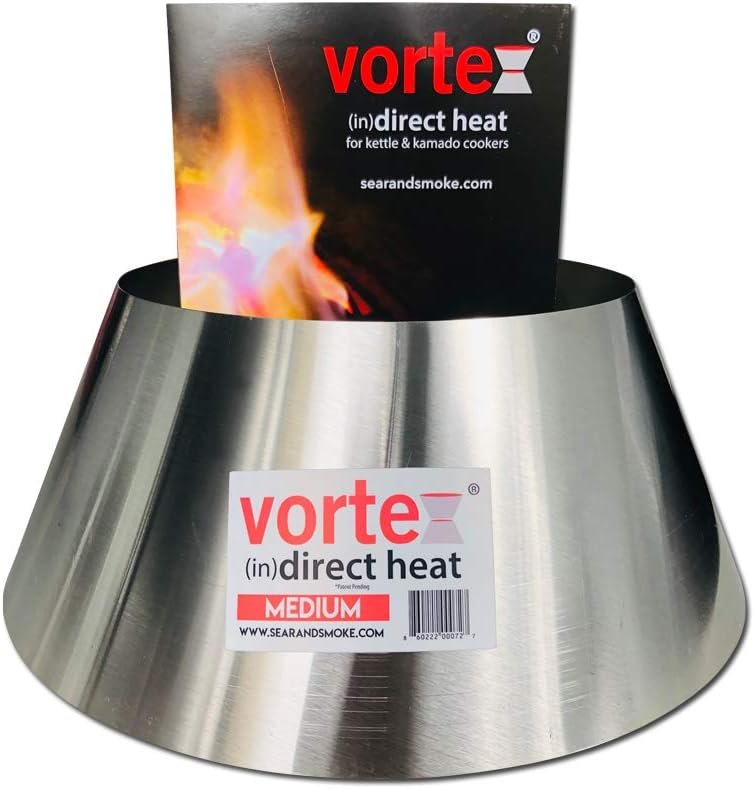
Choosing the right indirect-direct heat accessory for charcoal grills
Selecting the right insert or heat director for a charcoal kettle or kamado can change cooking outcomes more than many realize. For cooks focused on achieving both crispy, high-heat results and precise low-and-slow smoking, a purpose-built vortex insert redirects radiant heat and alters airflow inside the dome to create predictable cooking zones. This review examines the medium VORTEX BBQ insert (part SS-V-01-A) as an accessory for Weber kettles, XL kamados and other compatible charcoal cookers, emphasizing how its construction, placement and interaction with charcoal and venting influence searing, indirect smoking and radiant roasting. The goal is to translate manufacturer specifications, materials details and aggregated user themes into practical considerations for buyers choosing a solution that must balance heat intensity, airflow management, placement flexibility and cleanup effort without implying hands-on testing or personal use.
Quick Overview
| Feature | Details |
|---|---|
| Product type | Medium VORTEX BBQ insert (heat deflector/insert) |
| Fuel type | Charcoal accessory (designed for lump or briquette charcoal) |
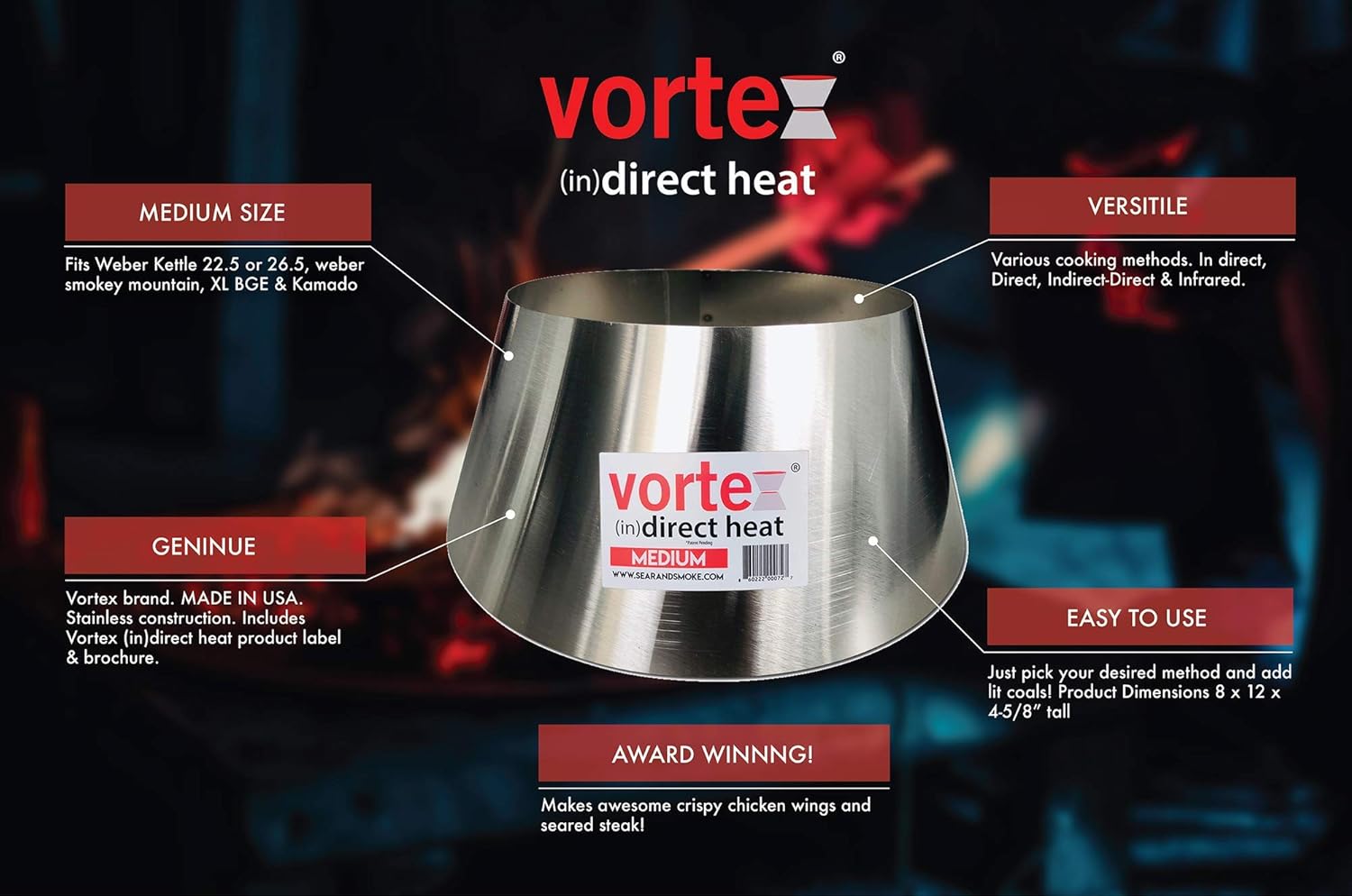
| Compatible grills | Fits Weber Kettle 18, 22 & 26; XL Big Green Egg; Big Joe; other XL kamados and UDS-style cookers |
| Product dimensions | 12 x 12 x 4.63 inches; 1.32 pounds |
| Materials & construction | Manufactured in USA; model number SS-V-01-A indicates stainless-steel construction and stamped branding |
| Control system | Manual — relies on host grill’s charcoal placement and venting for temperature control |
| Typical temperature roles | Enables indirect low-and-slow smoking and high-heat indirect searing; exact temps depend on charcoal load and vents |
| Best suited cooking styles | Indirect smoking, indirect-high searing, radiant roasting, crisping poultry skin |
| Intended use cases | Wings, seared steaks, whole-bird roasting, converting kettles into indirect smokers |
| Warranty | Manufacturer warranty not specified in public listing |
The specifications show a compact stainless-steel insert intended to redirect charcoal heat for indirect and indirect-direct cooking. In practice, the accessory converts a single-basin charcoal cooker into distinct cooking zones by concentrating coals around the perimeter and channeling radiant energy upward and back down, creating an area for centered roasts or high-heat searing while relying on the host grill’s venting for temperature control.

Cooking style suitability: grilling, smoking, or hybrid use
The VORTEX medium insert is positioned as a multi-mode accessory that adapts a charcoal kettle or kamado into a device capable of indirect low-and-slow smoking, high-heat indirect searing and radiant roasting. Its geometry is designed to act as a heat riser and deflector: when mounted narrow-side up or wide-side up, the unit either concentrates upward radiant heat for crisping and searing or redirects heat laterally for indirect smoking. Buyers must consider the host grill’s airflow and grate placement, as the insert changes primary heat transfer from direct convection and conduction to a mix of radiant and reflected heat, enabling combination cooking styles without adding separate burners or a secondary box.
Suitability for low-and-slow smoking
For low-and-slow applications, the insert’s design redirects heat upward and around the food, allowing coals to be placed peripherally in snake or minion configurations. This creates a reduced convective direct-heat path to the food and increases the component of indirect radiant energy, which helps maintain stable low temperatures when combined with controlled venting. Performance will depend on charcoal quality, vent adjustments and grill insulation; a well-regulated kettle or kamado can hold smoking temperatures in the 225–300°F band with this accessory when used with appropriate fuel management.
Suitability for high-heat searing and radiant roasting
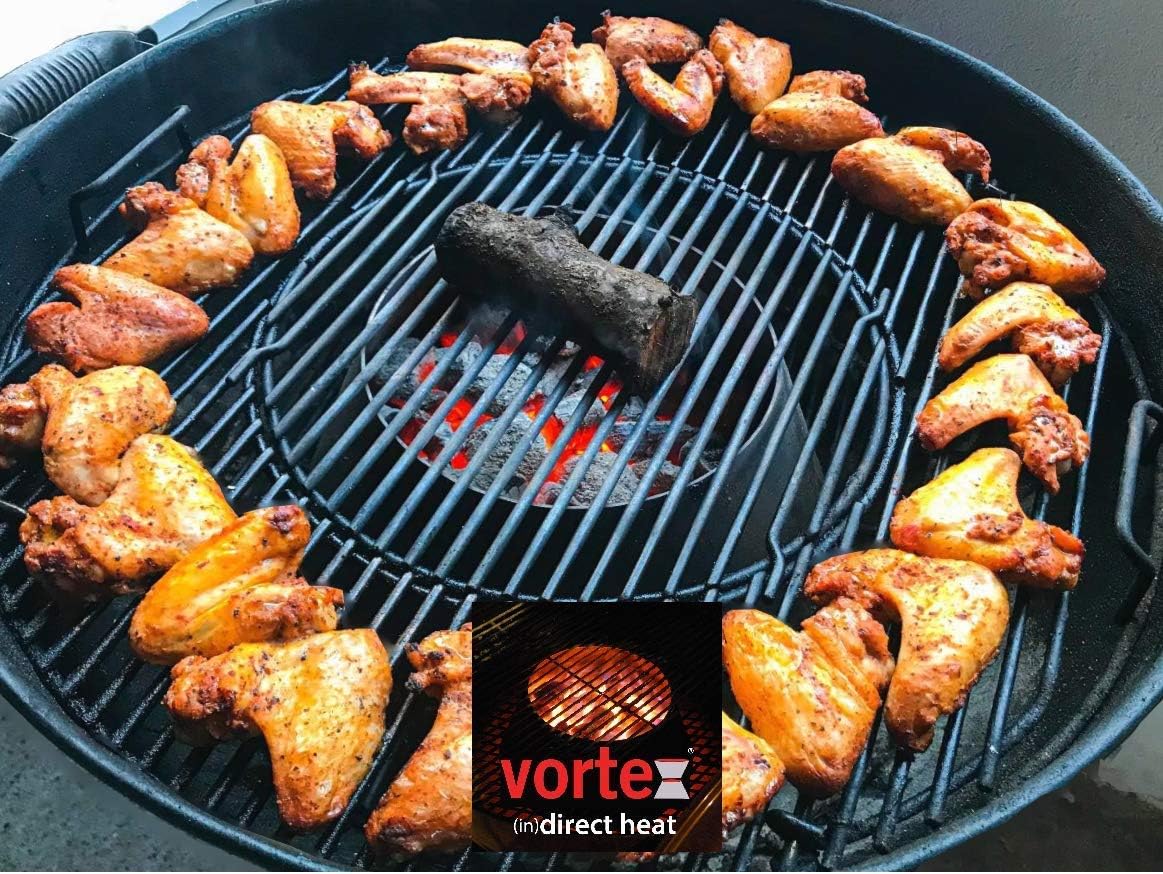
When used wide-end up or with coals concentrated beneath the narrower opening, the insert can function as a focused radiant source that reflects intense heat back to the center, supporting searing-style surface temperatures. This geometry mimics infrared-style radiant cooking by increasing direct radiant flux to the food while preventing direct flame contact. For searing steaks or rendering skin, the insert produces high localized heat that promotes Maillard reactions without necessarily exposing the food to flame flare-ups, though the ultimate sear intensity depends on coal mass and vent settings.
Fuel type impact and compatibility with charcoal cookers
The accessory is explicitly a charcoal-focused device and its performance is tightly coupled to fuel selection and combustion strategy. Lump charcoal and high-quality briquettes react differently under the insert: lump lights faster and can reach higher peak temperatures for searing, while briquettes provide steadier, longer duration heat for smoking. Using the insert in combination with a minion or snake lighting method allows extended indirect sessions, whereas a direct high-heat build with dense coal loads supports short searing windows. Pellet or gas-fired hosts are not suitable for this insert; fuel chemistry and ash production from charcoal influence airflow and the insert’s effectiveness.
How charcoal type affects temperature control and flavor
Lump charcoal’s variable density leads to quicker heat ramps and higher peak temperatures, advantageous for searing with the insert but requiring closer vent discipline. Briquettes burn more uniformly and produce consistent bed temperatures conducive to long-duration smoking when combined with the VORTEX placed narrow-side up. For smoke flavor, adding measured chunks of hardwood directly on or near the insert will produce flavored smoke; however, the insert’s geometry can dissipate some particulate smoke if airflow is aggressive, making chunk size and placement important for flavor retention.
Considerations for fuel-efficiency and ash management
Because the insert centralizes heat via radiant reflection, it can yield fuel efficiency benefits when used correctly: perimeter coal placement and controlled venting minimize direct convective losses and extend burn duration in snake/minion configurations. However, ash accumulation beneath and around the insert can impair airflow over time. Choosing charcoal with low ash content and periodically removing ash from the fire grate maintains consistent combustion, and lightweight inserts like the medium VORTEX will require routine ash clearing to preserve predictable fuel-to-air ratios during extended cooks.
Temperature range and control precision using the insert
Temperature control with the VORTEX relies on three variables: charcoal load and type, host grill vent adjustment, and insert orientation. The accessory itself does not provide digital control; instead, it alters how heat radiates and circulates, converting a single heat source into distinct zones. With correct coal placement and venting a user can expect stable smoking setpoints in the mid-200s and high searing radiance for short intervals above 500°F on well-insulated kamados or fully ventilated kettles. Buyers seeking precision should pair the insert with accurate vent operation and a reliable thermometer; the insert improves zone stability but does not substitute for active fuel and vent management.

Techniques to achieve repeatable temperatures
Repeatability comes from consistent charcoal mass, consistent vent settings and repeatable insert orientation. For smoking, a lower charcoal mass combined with partial vent closure and a snake or minion layout yields long, steady burn with minimal temperature drift. For searing, a dense, hot coal bed with fully open vents and the insert oriented to concentrate radiant heat will produce short-duration high-temperature performance. Temperature probes and predictable fuel loads are critical because the VORTEX changes heat transfer dynamics but does not automate control.
Limitations to control precision and mitigation strategies
Precision is limited by the accessory’s passive nature and the host grill’s venting resolution. Small changes in vent position or coal distribution produce larger temperature shifts than in multi-burner systems with active feedback. To mitigate this, use consistent charcoal brands, staged coal additions for long cooks and multiple thermometers for monitoring. For users requiring digital PID-style control, the insert is best combined with external controllers only if the host cooker is compatible with automated airflow management.
Heat distribution and airflow management inside kettles and kamados
The VORTEX alters internal airflow patterns by redirecting radiant heat upward and outward; it effectively separates the cooking chamber into a central radiant zone and a peripheral coal bank. This dual-zone arrangement is valuable when converting a direct-heat kettle into an indirect smoker or when aiming for even roasting without direct flame contact. Airflow still originates from the lower intake and upper exhaust vents of the host grill, so the insert’s performance depends on those vents’ sizing and the cooker’s insulation. Properly matched vent adjustments and charcoal staging create steady laminar flow paths and consistent temperature gradients across the cooking grate.
How insert geometry affects heat flow and hotspots
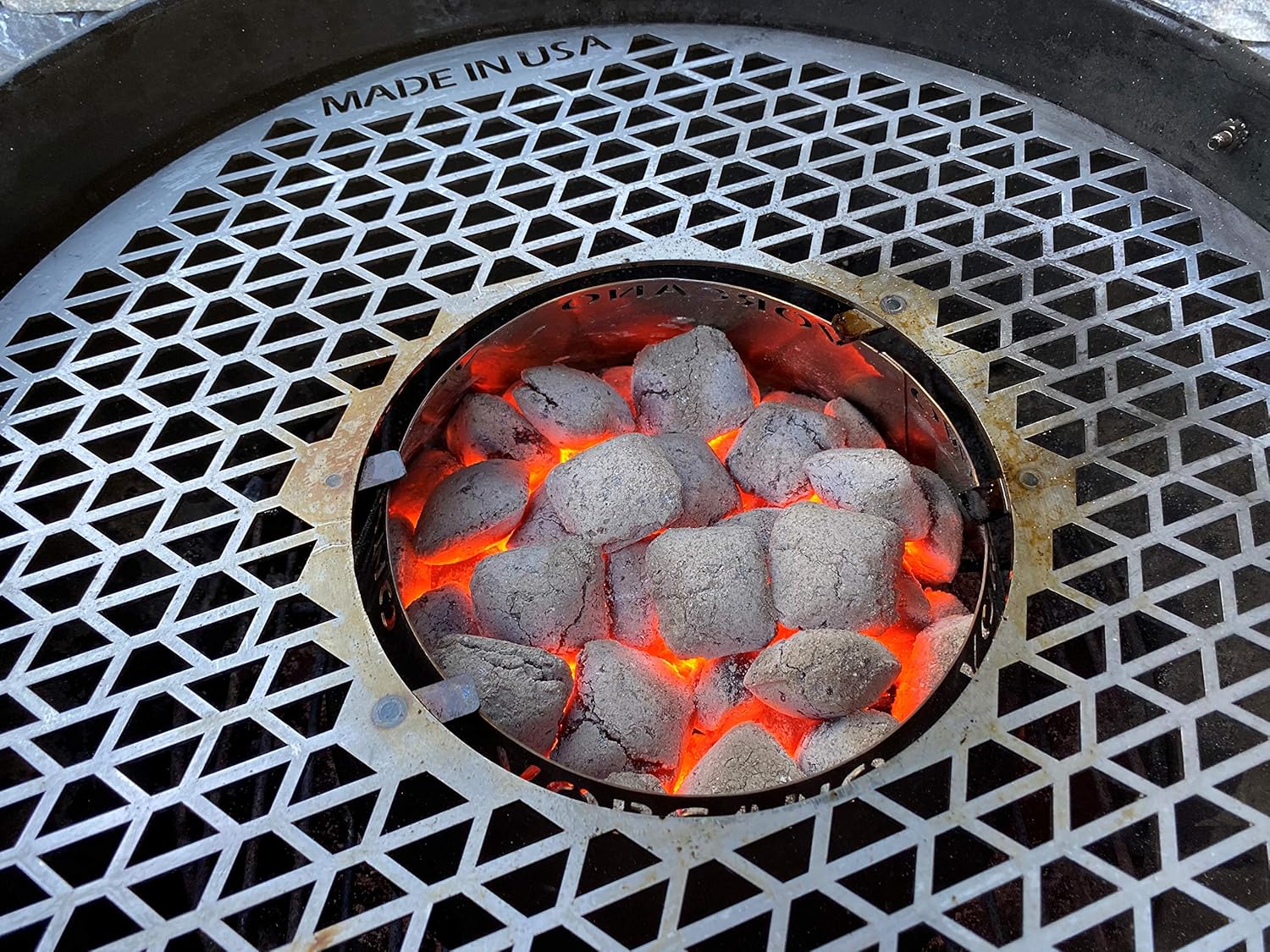
The VORTEX’s cone-like geometry produces a chimney effect that funnels hot gases upward and then disperses radiative energy downward toward the center. This reduces hotspot formation directly above coals and spreads a more even radiant field across the central cook zone. When used with perimeter coal placement, the result is a moderated center temperature with elevated peripheral convective heat. Grate positioning higher above the insert increases radiant influence; lower grates increase convective transfer, so placement relative to the insert is a practical tuning parameter.
Ventilation strategies for predictable airflow
Achieving steady airflow requires balancing the bottom intake and top exhaust vents to control oxygen supply and gas exit velocity. For low-and-slow runs, smaller intake apertures with a partly open exhaust create slower flows and stable smoke retention. For searing, wide-open vents maximize oxygen and promote fast combustion and higher radiant output. The insert can amplify the effects of these vent changes, so small adjustments should be made incrementally while monitoring temperatures.
Cooking capacity, surface area considerations, and placement
As an insert rather than a full grill, the VORTEX does not change the host grill’s total grate area but alters usable zones and effective cooking surfaces. Center placement above the insert creates a dedicated radiant hotspot ideal for roasts and searing portions, while the perimeter remains suitable for indirect placements or lower-heat items. Compatibility with multiple kettle sizes and XL kamados expands flexibility, but overall capacity is constrained by the host grate size, vertical clearance above the insert and the need to place coals around the periphery rather than directly beneath every food item.

Planning cook layouts and capacity expectations
With the medium VORTEX installed, plan to use the central area for the main protein where radiant intensity is desired and reserve outer zones for lower-temperature sides or indirect meat placements. Vertical clearance dictates whether multi-tier cooking with elevated racks is feasible; taller kamados typically allow more vertical space for multi-rack setups. For large batch smoking, perimeter coal layouts reduce direct grate area and will slightly lower the number of items that can be placed directly over heat, so portion planning is important when maximizing throughput.
Placement constraints and accessory compatibility
Compatibility lists indicate the insert fits common kettle diameters and several XL kamados, but differences in grate height and bowl depth alter how the insert performs. Shallow kettles place the grate closer to the insert and increase radiant intensity, while deeper kamados provide more room for heat dispersion and low-temp smoking. Buyers should verify grate-to-insert clearance on their specific cooker and consider additional raised grates or indirect racks to maintain desired cooking distances.
Durability, maintenance expectations, and service life considerations
The medium VORTEX’s model number and public listing indicate stainless construction and USA manufacturing, suggesting corrosion resistance and mechanical stability typical of stainless-steel grill accessories. Expected lifespan is tied to material grade, cleaning frequency and exposure to thermal cycling and acidic residues. Regular ash removal, avoidance of prolonged saltwater exposure and periodic inspections for warping or fatigue extend usable life. Because the manufacturer warranty isn’t specified publicly, longevity depends on build material and proper care rather than a documented coverage period.
Routine cleaning, ash management and corrosion prevention
Routine cleaning involves removing ash and creosote buildup after cool-down to prevent airflow restriction and corrosive residue accumulation. Stainless components should be brushed and, when necessary, scrubbed with non-abrasive cleaners to remove carbon deposits. Avoiding harsh chloride-based cleaners and minimizing extended exposure to wet storage conditions reduces the risk of pitting. For heavy-use scenarios, periodic surface inspections for deformation or thinning help identify end-of-life signs before performance losses occur.
Repairability, replacement and expected lifecycle
The simple stamped or formed geometry and light weight make the insert straightforward to replace if damaged, and parts are readily obtainable from the manufacturer or reseller. Mechanical failure is most likely from extreme thermal cycling or physical impact rather than normal use. In typical home-use regimes with regular cleaning and responsible storage, stainless-steel inserts of this type commonly provide multiple seasons of service, with lifecycle expectations tied to loading patterns and exposure to corrosive agents.
Pros & Cons
Pros
- Versatile cooking modes: The VORTEX supports indirect low-and-slow smoking, high-heat indirect searing and radiant roasting by changing insert orientation and coal placement, enabling multiple styles on one charcoal platform.
- Broad compatibility: Designed to fit common kettle diameters and several XL kamados, expanding the functionality of established charcoal cookers without major modifications.
- Compact, lightweight construction: At roughly 1.3 pounds and 12 x 12 x 4.6 inches, the medium insert is easy to position and remove, which simplifies transitions between cooking modes and storage.
- Fuel-efficiency potential: By redirecting radiant heat and enabling perimeter coal layouts for minion or snake methods, the accessory can extend burn duration and reduce charcoal wastage when used with controlled venting.
- Stainless construction and Made-in-USA branding: Model SS-V-01-A and manufacturer details indicate corrosion-resistant materials and domestic manufacturing oversight, which typically improves quality control.
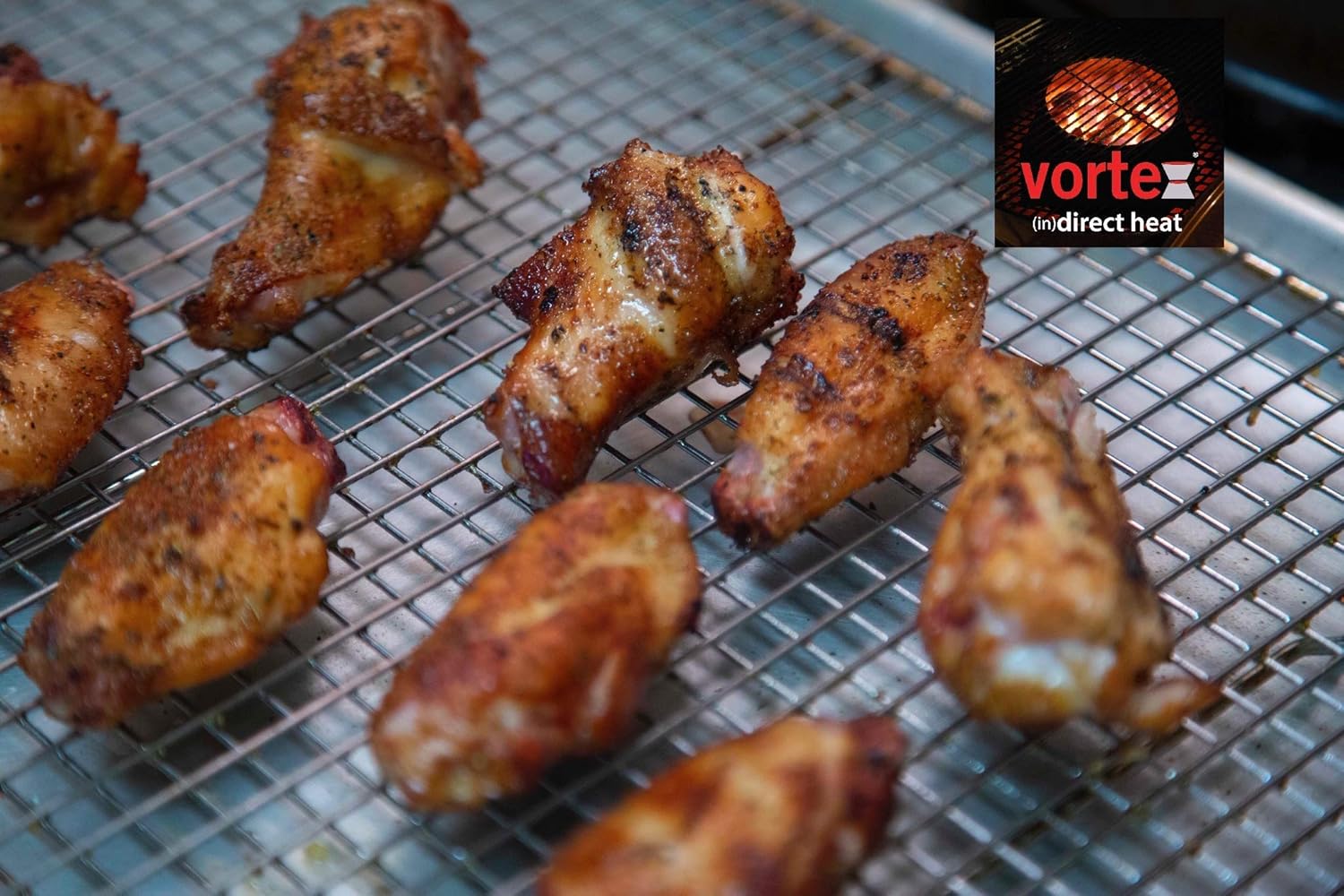
- Enhances skin crisping and sear outcomes: Geometry is intended to focus radiant energy to achieve crispy poultry skin and intense sears without direct flame contact, reducing flare-up risk inherent to direct grilling.
Cons
- Passive control limits precision: The insert relies entirely on host grill venting and fuel management; it does not provide automated temperature control, so precise PID-like stability requires user skill and monitoring.
- Reduced direct grate area for some cooks: Perimeter coal placement and central insert occupation mean less direct grate space over coals for simultaneous direct grilling of many items.
- Ash accumulation impact: Users report that ash buildup beneath and around inserts can restrict airflow over long cooks, requiring periodic cleaning during extended sessions to maintain consistent combustion.
- Warranty ambiguity: Public listings do not specify a manufacturer warranty, so buyers must rely on product construction and reseller policies rather than documented manufacturer coverage.
Final Verdict: Who this accessory is best for (and who should skip it)
The medium VORTEX insert is a pragmatic choice for charcoal cooks seeking a single accessory to expand their kettle or kamado’s capability across smoking, radiant roasting and high-heat searing without installing a separate smoker box or buying a second cooker. It is best suited to users comfortable with manual fuel and vent control, who value multi-mode versatility, portability and an accessory that improves skin crisping and controlled searing. It pairs well with cooks who already rely on charcoal and who prioritize heat manipulation through coal placement and venting rather than automated control.
This insert is not ideal for users who require digital temperature automation, large-capacity direct grilling without sacrificing grate area, or those who prefer gas, pellet or electric systems as their primary fuel source. Compared to similarly positioned accessories available in 2026, the VORTEX medium stands out for its compact geometry, material indications of stainless construction and broad compatibility, but it remains a passive tool that demands procedural knowledge to deliver repeatable results.
Frequently Asked Questions (FAQs)
Can the VORTEX insert convert a standard kettle into a reliable indirect smoker?
Yes. The insert redirects heat and enables perimeter coal layouts like the snake or minion method, which, when combined with controlled venting, support sustained low temperatures suitable for indirect smoking. Performance depends on coal consistency, host grill insulation and vent adjustment; the insert is a passive aid that improves indirect heat flow but requires active management of fuel and vents for reliable smoking sessions.
What charcoal types work best with this insert for searing vs smoking?
Lump charcoal is preferred for quick, high-peak temperatures and stronger radiant searing, while briquettes offer steadier, longer-duration heat for low-and-slow smoking. For searing, use a dense, hot lump charcoal load with vents open. For smoking, use a controlled briquette mass with reduced intake and measured exhaust to stabilize mid-200s temperatures in combination with the insert.
How does the VORTEX affect temperature control and do users need additional thermometers?
The insert modifies heat transfer by increasing radiant and reflected energy; it does not provide active control. Accurate temperature management still depends on the host grill’s vents and fuel strategy. Using at least one reliable probe-style thermometer for the cooking chamber and a second for food surface monitoring is recommended to achieve consistent results and to compensate for the insert’s passive nature.
Is the VORTEX compatible with all kamado and kettle models?
The medium VORTEX is listed as compatible with common kettle diameters (Weber 18, 22, 26) and several XL kamados like Big Green Egg XL and Big Joe models, but compatibility varies with grate diameter and bowl depth. Buyers should verify grate-to-insert clearance on their specific cooker and confirm that the insert dimensions match the host grill before purchase.
What maintenance steps prolong the life of the stainless-steel insert?
Routine ash removal after cool-down, brushing to remove carbon deposits and occasional non-abrasive cleaning prevent airflow restriction and corrosive buildup. Avoid chloride-based cleaners and wet storage conditions to minimize pitting. Regular inspection for warping or thinning from thermal cycling helps identify when replacement is needed; responsible cleaning and storage substantially extend service life.
Does the insert reduce available grilling space for direct-heat cooking?
Yes. Because coals are typically placed around the perimeter when using the insert, some direct-heat grate area is sacrificed in favor of distinct indirect and radiant zones. The insert occupies central space, so users planning to cook many direct-grill items simultaneously should consider layout trade-offs or remove the insert for full direct grilling.
Can wood chunks be used with the insert for added smoke flavor?
Wood chunks can be used for smoke flavor, either placed directly on coals in the perimeter bank or positioned near the insert according to the manufacturer’s guidance. Because the insert alters airflow, chunk size and placement affect smoke production and retention; small, controlled pieces generate steady smoke without excessive particulate that could be blown through the chimney in aggressive-flow setups.
Is a warranty provided for the VORTEX medium insert?
Public listings do not specify a manufacturer warranty for this model. Potential buyers should consult the manufacturer or authorized resellers for explicit warranty information. In the absence of a stated warranty, product longevity depends on material construction, usage patterns and adherence to recommended care and maintenance practices.