
Why thermometer choice matters for grilling and smoking
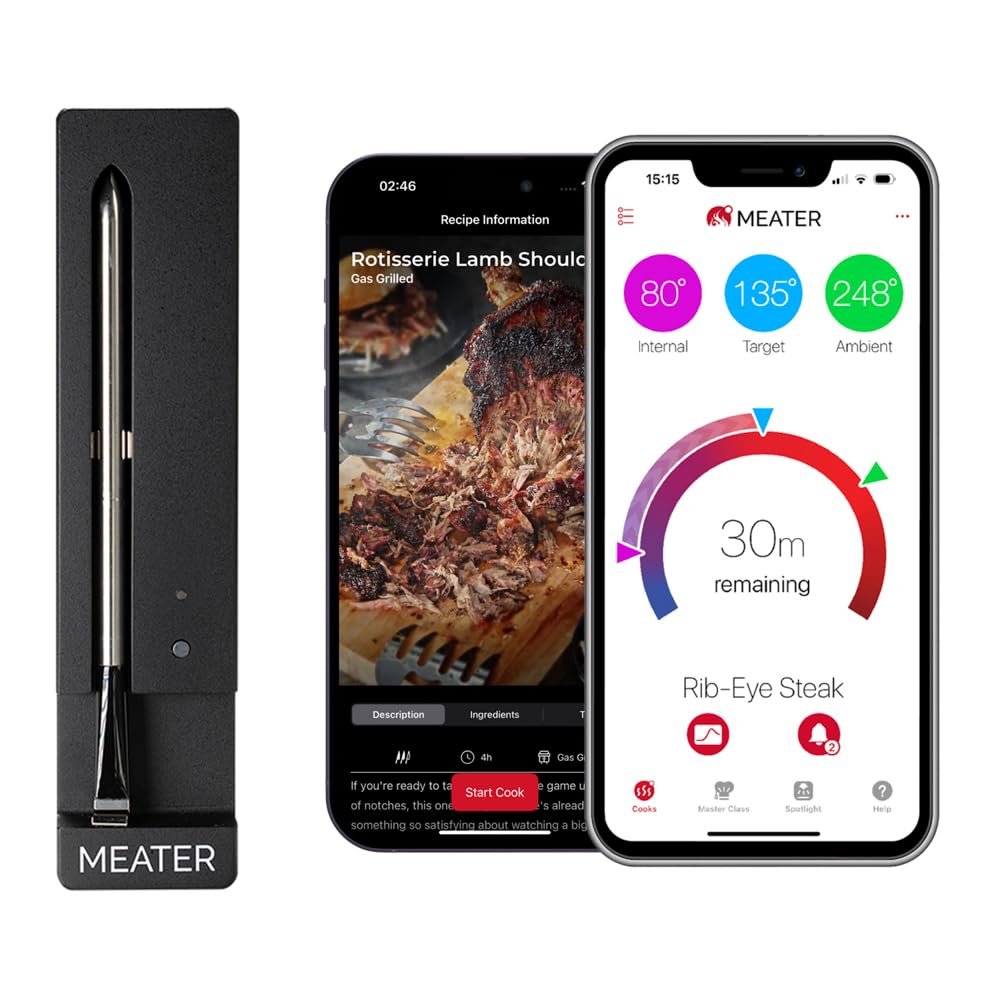
Selecting the right meat thermometer is a critical decision for home cooks who value repeatable results across grilling, smoking, roasting, and oven use. Probe thermometers bridge the gap between visual cues and internal doneness by delivering numerical feedback that aligns with safe and desired cook targets. Buyers focused on long cooks, multi-zone smokers, or remote monitoring need to weigh sensor accuracy, ambient sensing capability, connectivity range, and battery life. The MEATER SE positions itself as a wireless dual-sensor probe with app-guided cooking; its ambient upper limit of 527°F, 3-second response time, and advertised Bluetooth range up to 165 feet are specification-led metrics that influence which cooks and cooking environments it best serves.
Quick Overview
| Feature | Details |
|---|---|
| Device type | Wireless dual-sensor meat probe thermometer |
| Connectivity | Bluetooth (up to 165 feet line-of-sight, manufacturer stated) |
| Temperature range | Internal probe range down to 32°F; ambient rated to 527°F |
| Sensors | Dual sensors: internal meat and ambient/oven sensor |
| Materials & construction | Stainless steel probe tip, plastic charger case; dishwasher-safe probe |
| Power & runtime | Rechargeable probe — up to 24 hours per charge; includes AAA battery for charger |
| Response time | Manufacturer-stated 3 seconds for readings |
| Control system | App-guided with alerts and guided cook system (MEATER app) |
| Best-suited cooking styles | Grilling, smoking, roasting, oven, air fryer monitoring |
| Intended use cases | Remote temperature monitoring, guided cooks, long smokes and roasts |
| Certifications | CE, FCC, RoHS |
| Warranty | Refer to manufacturer documentation (Apption Labs) |
The table shows core specifications that translate to practical performance: dual sensors enable simultaneous internal and ambient monitoring for precision cooks, the 527°F ambient ceiling allows use on searing grills or in ovens, and Bluetooth connectivity with a rechargeable probe supports both short-distance backyard monitoring and indoor observation during long smokes when line-of-sight conditions are favorable.

Temperature control and sensor performance
MEATER SE emphasizes dual sensing and a smart algorithm to estimate remaining cook time; the internal probe sensor measures core meat temperature while the secondary sensor reads ambient or oven temperature, providing the data inputs necessary for predictive cook-time modeling. The manufacturer-stated response time of three seconds supports responsive readout updates, and the probe’s ambient limit of 527°F defines the upper safe range for placement in direct-heat environments. Buyers prioritizing precision should consider that wireless read accuracy also depends on correct probe placement, steady ambient conditions, and app calibration logic rather than manual probe calibration, since the device is marketed as maintenance-free without user calibration.

Probe and dual-sensor function explained
The MEATER SE uses a single physical probe with two sensing points: a tip-mounted internal sensor for meat temperature and a separate ambient sensor positioned along the probe body. This arrangement follows common industry practice for combined internal/ambient monitoring and allows one instrument to report both core doneness and cooking chamber conditions. For accurate results, the internal sensor tip should be centered in the thickest part of the cut while the ambient sensor must remain exposed to the cooking chamber air rather than blocked by meat or placed too close to a direct flame. The dual-sensor design provides the data a predictive algorithm needs to estimate carryover and remaining time.
Response time, battery life, and charging considerations
Manufacturer disclosures indicate a three-second response time for temperature updates and a rechargeable probe battery rated up to 24 hours per charge with about two hours required for a full recharge. The included plastic charging case and supplied AAA battery are part of the system that provides probe power and Bluetooth relay. Long runs such as extended smokes will rely on the 24-hour claim and conservative power management; users should allow headroom for longer cooks or verify charging status before starting. Bluetooth connectivity and frequent polling by the app can influence battery drain depending on settings and environmental interference.
Cooking style suitability and fuel-type impact
The MEATER SE is framed as a multi-purpose probe suitable for grilling, smoking, roasting, and oven or air-fryer use, with firmware and app guidance to match those modes. Fuel type influences thermal dynamics—charcoal and wood setups produce large temperature swings and localized hot spots, gas provides faster recovery and more consistent air temperatures, while electric and pellet systems offer steadier ambient control. Because the SE reports both ambient and internal metrics and allows real-time monitoring, it can inform decisions across fuel types, but performance for long, indirect low-and-slow cooks depends on the probe’s ability to maintain Bluetooth connectivity and battery duration in the chosen rig.

How the SE fits charcoal and wood smoking
Charcoal and wood smoking create uneven chamber temperatures and high radiant heat zones that make ambient readings more variable; the SE’s ambient sensor helps track chamber trends but cannot mitigate local hotspots caused by close coals or direct flames. For accurate smoke cooks, the probe should be placed away from direct flame and in the airflow path that represents the bulk cooking zone. The app’s predictive model will be more reliable when ambient temperatures change predictably. Bluetooth range and battery life must be considered for multi-hour smokes where the user may be distant from the cooker.
Performance with gas, electric, and pellet systems
Gas, electric, and pellet grills typically deliver more consistent ambient temperatures and faster recovery after lid openings, which suits the SE’s ambient/internal feedback model. These systems can produce stable conditions where Bluetooth updates and the SE’s predictive timing provide actionable guidance. For gas searing and high-heat finishing, the probe’s 527°F ambient rating allows placement in many high-heat scenarios, but direct flame contact and flare-ups should be avoided to prevent damage and inaccurate readings.
Heat distribution, airflow, and probe placement
Any probe thermometer’s effective accuracy is a function of sensor placement relative to heat sources and airflow. The MEATER SE reports ambient chamber temperature in addition to internal meat temperature, which helps interpret heat distribution when placed in representative airflow rather than directly over coals or too close to searing zones. In multi-zone setups, single-point ambient sensing provides a snapshot rather than a map; cooks who require multi-zone monitoring should be aware that one probe cannot replace multiple chamber thermometers. Airflow, lid openings, and fuel additions change ambient conditions rapidly, so interpretive best practice is to use the SE’s ambient reading as trend guidance rather than an absolute across wide cooking surfaces.

Probe placement effects on ambient readings
Ambient sensor placement determines whether reported chamber temperature reflects the true cooking zone. When the ambient sensor is tucked against meat or blocked by the protein, readings will skew cooler or fail to reflect heat exposure. Conversely, placement too close to the heat source yields higher localized readings that overstate the general chamber temperature. For most grills and smokers, placing the probe so the ambient sensor sits in the typical airflow path above or beside the meat and away from direct flame produces a representative ambient reading for algorithmic timing and cook control.
Interpreting ambient vs internal temperatures for searing and smoking
Internal and ambient values serve different functions: internal temperature signals doneness, while ambient temperature indicates the cooking environment and guides heating strategy. During searing, short-term ambient spikes do not immediately change core temperature but will affect surface browning; using ambient data alongside time-based searing recommendations can reduce overcooking. For smoking, stable ambient trends better predict how long low-temperature cooking will take; the SE’s algorithm uses both channels to estimate remaining cook time, so correct interpretation means using ambient readings to manage fuel and airflow, and internal readings to determine final pull temperature.
Maximum ambient temperature and oven-safe use
The MEATER SE’s ambient upper rating of 527°F defines the manufacturer-declared ceiling for safe probe exposure to cooking chamber heat, allowing use in ovens, grills, searing finishes, and many air-fryer environments where temperatures commonly remain below that limit. That rating should be observed to avoid sensor damage or degraded accuracy; users should avoid direct contact with open flames or extremely localized radiant heat that exceeds the ambient rating. Oven-safe construction and dishwasher-safe cleaning for the probe body are specified by the manufacturer and suit the product to indoor roasting and oven monitoring workflows.
Durability, maintenance, and who should avoid the SE
Durability and longevity are functions of materials, operating conditions, and maintenance. MEATER SE combines a stainless steel probe tip with a plastic charging case and dishwasher-safe construction, and it meets CE, FCC, and RoHS specifications, which speak to regulatory compliance rather than mechanical lifespan. Repeated exposure to ultra-high localized heat, frequent drops, or corrosive environments can limit expected service life. Buyers requiring multi-probe simultaneous monitoring, ruggedized field use in professional kitchens, or wired, multi-point chamber mapping may find the SE’s single-probe wireless design limiting compared with multi-probe wired systems or built-for-commercial devices.

Materials, construction, and expected longevity
The probe’s stainless steel tip and sealed sensor assembly are standard for consumer-grade thermometers and resist corrosion from typical food juices and cleaning. The plastic charging case protects the probe and houses electronics, but plastics vary in long-term UV and heat resistance; keeping the charging case out of direct sun and away from extreme temperatures will help prolong structural integrity. Regulatory certifications (CE, FCC, RoHS) indicate compliance with safety and emissions standards, but lifespan depends on usage patterns, storage practices, and exposure to temperatures near the ambient limit.
Cleaning, maintenance, and waterproofing
Manufacturer disclosures indicate the probe is dishwasher-safe and oven-safe; the sealed construction simplifies routine cleaning after cooks. The plastic charging case and electronics should be cleaned per manufacturer instructions and protected from immersion or high-moisture storage. Waterproofing claims are listed among product features, but sealed electronics still benefit from drying and careful handling after exposure to steam or wash cycles. Regular inspection of the probe tip and cable interface (if applicable) helps identify wear that could affect accuracy.
Who should avoid the MEATER SE
The SE’s single-probe, wireless design can be unsuitable for users who require multiple simultaneous internal probes to manage large roasts or multi-rack smoking, or for professional kitchens that prefer rugged, wired thermometry and integrated control systems. Cooks who need multi-point chamber mapping to manage very large smokers or who demand guaranteed connectivity through thick walls or across long distances should consider multi-probe or hardwired solutions. Additionally, any application that exposes sensors to sustained temperatures consistently above the 527°F ambient limit is outside the device’s intended operating envelope.

Pros & Cons
Pros
- Wireless dual-sensor monitoring enables simultaneous internal and ambient readings, providing the data required for predictive cook-time algorithms and better carryover planning. The dual-sensor configuration aligns with industry practices for precision cooking.
- Long battery runtime and quick recharge support extended cooks; the manufacturer-stated 24-hour probe runtime and roughly two-hour recharge time make it practical for most overnight smokes when battery management and connectivity are ensured.
- App-guided cooking simplifies temperature targets and resting times by using algorithmic estimates based on both internal and ambient inputs, which helps less-experienced cooks follow established doneness parameters.
- 527°F ambient rating and oven-safe probe extend use beyond low-and-slow smoking into high-heat grilling, searing finishes, and oven roasting, increasing versatility for mixed cooking styles.
- Compact charger and dishwasher-safe probe reduce maintenance friction, and regulatory certifications (CE, FCC, RoHS) indicate compliance with common electrical and material standards.
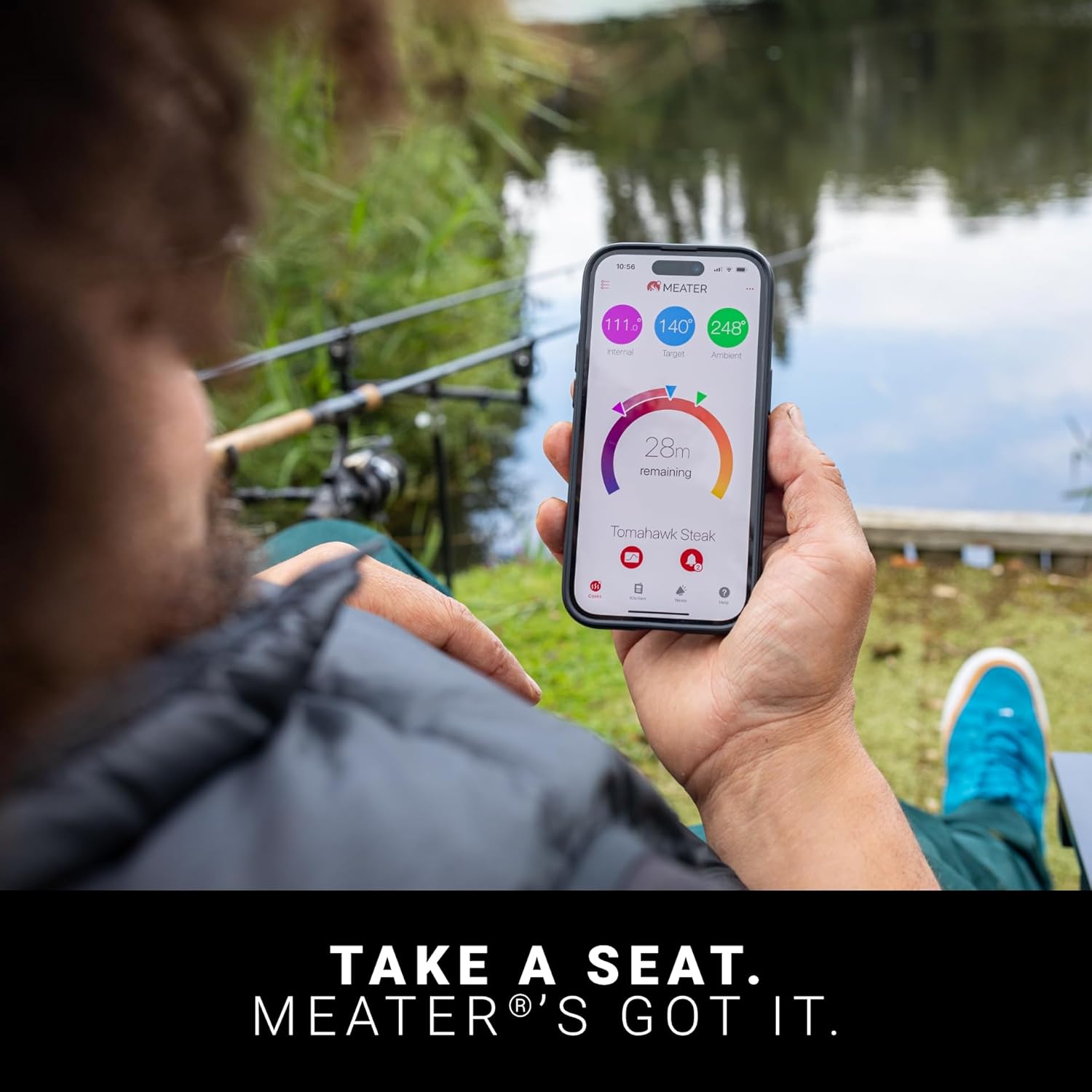
- Bluetooth range specification up to 165 feet supports remote monitoring in open, line-of-sight conditions, enabling at-home users to leave the immediate cooking area during long cooks.
Cons
- Single-probe design limits simultaneous monitoring to one piece of meat and one ambient point, which can be insufficient for large-capacity smokers, multi-rack racks, or users who require multi-point chamber mapping.
- Wireless connectivity is subject to environmental interference and obstructions; the advertised Bluetooth range is line-of-sight and may be substantially reduced through walls, trees, or structures common in backyard setups.
- The plastic charger and probe assembly, while convenient, may not match the ruggedness of professional-grade wired thermometers for high-frequency commercial use or heavy outdoor exposure.
- Ambient upper limit of 527°F, while suitable for most consumer applications, excludes repeated exposure to extreme radiant searing conditions and limits placement near direct flames or industrial broilers.
Final Verdict: Who This Thermometer Is Best For (and Who Should Skip It)
The MEATER SE is a specification-driven wireless probe thermometer geared toward home cooks who prioritize convenience, guided cooks, and combined internal/ambient monitoring for grilling, smoking, roasting, and oven use. Its dual-sensor design, dishwasher-safe probe, and app-led timing are well suited to weekend grillers, home smokers, and indoor roasters who value predictive timing and a compact, rechargeable system. The SE’s 527°F ambient rating and 24-hour battery claim extend its utility across a broad swath of consumer cooking scenarios without requiring wired connections or multiple instruments.
Users who should consider alternatives include professionals or serious hobbyists who need multi-probe coverage for large-capacity smokers, those who require ruggedized, commercial-grade devices, and cooks who must guarantee connectivity across substantial obstructions. Buyers who want multi-zone chamber mapping or extended-range wireless beyond typical Bluetooth capabilities may prefer multi-probe wired systems or dedicated wireless gateways that support multiple probes simultaneously. Overall, the SE presents a balanced option for at-home precision cooking where a single, smart, wireless probe meets common grilling and smoking needs.
Frequently Asked Questions (FAQs)
How accurate is the MEATER SE for internal and ambient temperature readings?
The MEATER SE uses two sensors—one at the probe tip for internal meat temperature and another along the probe body for ambient chamber temperature. Manufacturer specifications emphasize fast response updates and predictive algorithms, and reviewers commonly report reliable internal readings when the probe is properly positioned. Accuracy depends on correct placement, stable ambient conditions, and firmware/app interpretation rather than user calibration, as the device is promoted as maintenance-free.
Can the MEATER SE handle long overnight smoking sessions reliably?
Manufacturer-stated runtime is up to 24 hours per charge with roughly two hours for a full recharge, which supports many long smoke sessions. Practical reliability depends on Bluetooth connection stability, app polling frequency, and the cook environment. For extended overnight use, plan for battery headroom and verify charging and connectivity before starting because obstructions can reduce Bluetooth range and increase the likelihood of disconnects.
Is the MEATER SE suitable for use with charcoal, gas, pellet, and electric grills?
The probe is compatible across fuel types, but performance characteristics differ by fuel. Charcoal and wood create variable ambient conditions and hotspots that require careful probe placement. Gas, pellet, and electric grills generally provide steadier ambient trends, which improve the reliability of the device’s predictive timing. The 527°F ambient limit allows use across most consumer grilling situations, but avoid direct flame contact.
How should the probe be placed for the most representative ambient temperature reading?
For a representative ambient reading, position the ambient sensor in the general airflow path of the cooking chamber and away from direct flames, coals, or the meat surface. Avoid placing the ambient sensor blocked by the protein, as this can produce skewed values. Correct placement helps the MEATER SE’s algorithm estimate remaining cook time and manage carryover more accurately.
What maintenance and cleaning are required for the MEATER SE probe?
Manufacturer disclosures list the probe as oven-safe and dishwasher-safe, and sealed construction reduces routine maintenance. The charging case and electronics should be cleaned per Apption Labs guidelines and kept dry when possible. Regular inspection for physical wear, especially at the probe tip and any seals, will help ensure reliable performance over time.
Who should choose a different thermometer instead of the MEATER SE?
Users who need multiple simultaneous meat probes, multi-point chamber mapping, or rugged commercial-grade equipment may find the SE’s single-probe wireless design limiting. Also, those who require guaranteed connectivity through heavy obstructions or across lengthy distances should consider wired multi-probe solutions or systems with dedicated wireless gateways that support multiple sensors.