

Why grill choice matters for indoor cooking
Selecting the right indoor grill shapes everyday meal options, kitchen workflow, and long-term ownership satisfaction. Compact contact grills prioritize speed, convenience, and countertop storage, while sacrificing features required by traditional outdoor smokers or multi-fuel barbecues. For households that value rapid weeknight meals, panini pressing, and small-batch protein and vegetable grilling, electric contact grills deliver consistent plate-to-food heat transfer without open flames or fuel handling. Buyer expectations should center on cooking style (searing and press-grilling vs low-and-slow smoking), fuel trade-offs (electric plug-in limitations compared with gas or charcoal), temperature control precision, and maintenance needs such as removable plates and dishwasher-safe components. Durability, warranty coverage, and materials influence expected lifespan, while cooking capacity and drainage design determine whether a single appliance can replace multiple devices for a couple or small family.
Quick Overview
| Feature | Details |
|---|---|
| Grill type | Electric contact grill and panini press |
| Fuel type | Electric, 110-120V, 1800 watts |
| Total cooking area | 60 square inches (4-serving size) |
| Temperature control | Single fixed setting; no adjustable thermostat |
| Materials & construction | Ceramic-coated removable plates (George Tough nonstick) |
| Control system | Manual on/off with improved heating elements |
| Best suited styles | Quick grilling, paninis, searing, vegetables |
| Intended use cases | Indoor countertop cooking for couples or small families |
| Warranty | Limited warranty (manufacturer-provided) |
The 60-square-inch footprint and electric 1800-watt heating profile make this model well-suited for quick contact grilling and pressed sandwiches indoors. The removable ceramic-coated plates simplify cleanup, while the single fixed setting and contact-plate design limit low-temperature smoking and long-format barbecue techniques. The product targets users who prioritize fast heat-up, simple controls, and compact capacity rather than precise thermostat control or multi-fuel versatility.

Cooking style suitability: grilling, smoking, and hybrid use
The primary buyer decision is whether the appliance matches the intended cooking style; the George Foreman 4-serving contact grill is engineered for direct contact grilling and pressing, not for traditional smoking or indirect low-and-slow barbecue. The contact-plate arrangement creates top-and-bottom conduction heat that expedites searing and reduces cook times for burgers, chicken breasts, fish, and pressed sandwiches. Smoking requires sustained low temperatures, controlled airflow, and combustible fuel or pellet-generated smoke, which are not functions of a closed electric contact grill. For users seeking occasional smoky flavor, external liquid smoke or pre-smoked ingredients can supplement results, but those methods do not replicate pellet- or charcoal-driven smoke penetration achieved by purpose-built smokers.

Best uses: quick grilling, paninis, and weeknight meals
This grill’s design excels at rapid, high-contact heat applications where surface sear and reduced cook time are priorities. The 60-square-inch cooking area accommodates four average-sized portions simultaneously, making it practical for couples or small families preparing burgers, chicken cutlets, vegetables, and pressed sandwiches. The George Tough ceramic nonstick surface reduces the need for added fats and simplifies food release, while the sloped plate drains grease away from cooking surfaces to a drip tray. These features combine to support fast meal throughput and straightforward portion planning but favor compact, single-surface recipes rather than large roasts or whole poultry.
Not suitable for smoking or low-and-slow barbecue
Limitations for smoking include the absence of smoke generation, low-temperature control, and extended burn durations required by smoking chambers. The enclosed contact-plate geometry and electric heating element prioritize conduction and rapid heat transfer, which work against maintaining stabile low temperatures over hours. Additionally, no dedicated smoke box, pellet feed, or charcoal chamber is present, and airflow control is minimal compared with dedicated smokers. Consumers focused on authentic smoked brisket, ribs, or pulled pork should evaluate dedicated electric smokers, pellet grills, or charcoal smokers designed to manage smoke chemistry and multi-hour thermal stability.
Hybrid approaches and accessory-based workarounds
Some cooking scenarios can bridge the gap between a contact grill and smoky flavor profiles using accessories or pre-prepared ingredients. Techniques include finishing with smoked salts or sauces, using pre-smoked meat, or employing stove-top smoking methods on separate equipment before finishing on the contact grill. While these approaches add smoke flavor to finished plates, they do not convert the appliance into a low-and-slow unit and may require additional tools and planning. Buyers should treat the grill as a fast-cooking surface and use hybrid methods only when occasional smoky notes are desired rather than consistent smoke-driven barbecue.
Fuel type impact: electric performance and indoor suitability
Fuel choice and the appliance’s electrical design are central to buyer decisions for indoor grilling. As an 1800-watt, 110-120V electric contact grill, the unit provides consistent, predictable plate temperatures when connected to household power but lacks the combustion-driven variability and smoke production of charcoal, gas, or pellet systems. Electric heating delivers clean indoor operation without open flames, making it appropriate for apartments, condos, and kitchens where indoor grilling is preferred or required. The trade-offs include lower peak radiant heat compared with open-flame gas and charcoal grills and no inherent smoke generation; these factors influence sear characteristics, flavor development, and the ability to perform longer smoking sessions.

Electric heating characteristics and efficiency
Electric elements convert incoming power into steady conduction heat distributed through the grill plates, often resulting in consistent surface temperatures and efficient energy transfer when plates are in direct contact with food. The 1800-watt rating supports rapid preheat and recovery during short cooking cycles, which typically translates to lower energy consumption for single-meal use compared with prolonged fuel burn in outdoor grills. However, the sealed contact design limits convective airflow and radiant searing intensity typical of flame-based grills, so sear color and smoke-reactive flavor compounds may be less pronounced. Electric systems favor repeatable results and straightforward temperature predictability for controlled, short-duration cooks.
Ventilation and indoor-use implications
Indoor electric grills remove the need for outdoor ventilation designed for open flames, but they still produce steam, smoke from fats, and airborne particulates during high-heat searing. Proper kitchen ventilation, such as an operating range hood or open windows, helps manage odors and airborne grease. Because no combustible fuels are present, indoor safety is simplified relative to gas or charcoal, but buyers should still follow manufacturer instructions regarding clearance, non-combustible surfaces, and proper disposal of collected grease. The closed contact design mitigates flare-ups common with open flame grills, reducing the risk of ignition from dripping fats.
Power requirements, placement, and portability
An 1800-watt appliance requires a standard household circuit but draws higher current than small countertop appliances, so users should avoid overloaded multi-outlet strips and confirm outlet and circuit capacity in kitchens with multiple heavy-load appliances. The compact footprint and light weight make the unit portable between storage and countertop positions, though the need for a nearby grounded outlet constrains placement. Portability suits occasional outdoor use on covered patios with a GFCI-protected outlet, but exposure to weather should be avoided unless the manufacturer explicitly rates the appliance for outdoor conditions.
Temperature range and control precision
Temperature management is a frequent buyer consideration, especially for cooks who require nuanced heat control for different proteins and techniques. This model features a single fixed setting with no adjustable thermostat or digital temperature readout; the manufacturer emphasizes rapid preheat and plate-to-food conduction rather than precise incremental control. As a result, temperature precision relies on the steady-state output of the 1800-watt heating elements and the thermal mass of the ceramic-coated plates. For cooks who need exact low-temperature ranges for sous-vide finishing or low-and-slow smoking, this design is limiting. For everyday searing, pressing, and quick grilling, the fixed-setting approach simplifies operation and reduces the learning curve.

Single-setting design: practical implications for cooking control
A lack of variable settings reduces decision fatigue and accelerates the cooking process for commonly grilled items, but it constrains the ability to adapt plate temperatures for delicate foods like thin fish fillets or precise vegetable charring. Without an adjustable thermostat, users should rely on timing, preheating, and food thickness to manage internal doneness. The ceramic nonstick surface helps reduce sticking at higher surface temperatures, but thin or delicate proteins may benefit from shorter contact times or preliminary lower-temperature preparation to avoid overcooking. The single-setting philosophy aligns with fast, repeatable results rather than fine-grained thermal control.
Heat-up speed, recovery, and searing potential
Improved heating elements and the 1800-watt rating are presented as enabling 35% faster heat-up compared with earlier iterations, which impacts how quickly the grill reaches usable conduction temperatures. Faster preheat reduces idle time and supports quick searing and turnaround during weekday cooking. In a contact grill, searing potential depends on plate surface temperature, conduction efficiency, and contact pressure; the fixed-design units deliver strong surface heat suitable for forming crusts on burgers and paninis. However, the absence of exposed flames and limited radiant heat mean color development may differ from open-flame grills.
Workarounds for limited temperature precision
When more control is desired, external infrared thermometers, probe thermometers, and trial-based timing can assist in achieving consistent internal doneness. For delicate items, partial pre-cooking at lower temperatures in an oven or sous-vide followed by finishing on the contact grill can provide better results than relying solely on the single setting. Additionally, adjusting food thickness or using oil-based marinades strategically can moderate surface heat uptake. These practical techniques help adapt the fixed-temperature contact grill to a wider range of recipes without altering the appliance.
Heat distribution, airflow management, and cooking surface design
Heat distribution and airflow characteristics determine how evenly food cooks and how reliably surface searing occurs across the cooking area. The grill relies on integrated heating elements that transfer energy through ceramic-coated plates, producing top-and-bottom conduction rather than open radiant heat. Plate geometry, thermal conductivity of the ceramic coating, and physical contact pressure influence zone uniformity. The sloped grilling surface is engineered to channel grease to a drip tray, which improves browning by reducing pooled fats but also alters local surface temperatures where grease is absent. Airflow is minimal within the closed clamshell design, so convective effects are reduced relative to open grills.
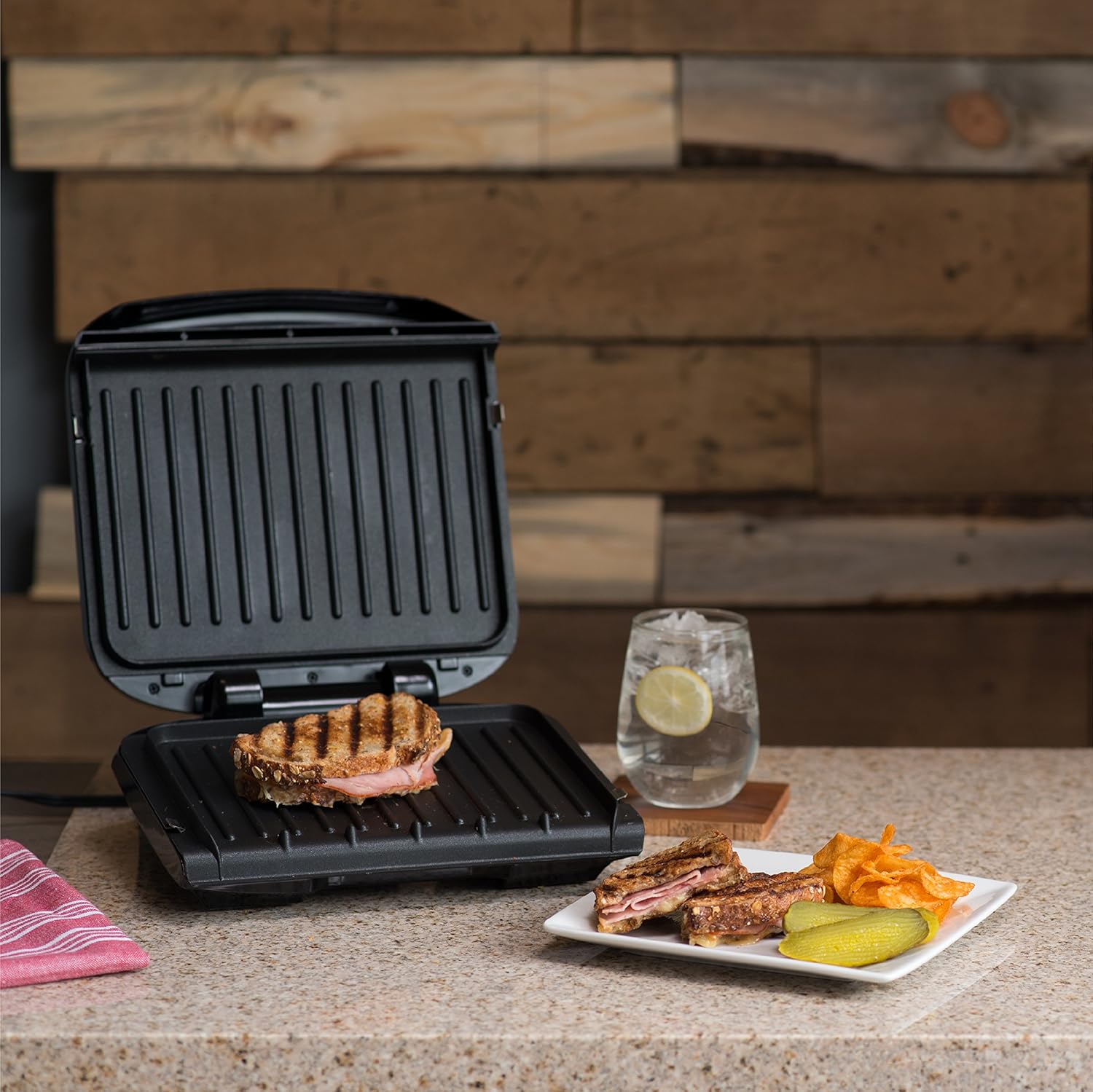
Plate design, thermal zones, and food contact
Removable ceramic-coated plates provide a flat, consistent contact surface that concentrates heat where the food makes direct contact, favoring uniform maillard reactions on exposed areas. Nonlinear plate temperature gradients can occur near edges or hinge points, where thermal mass and heat element proximity vary. Users preparing mixed-size items should stagger placement or rotate items to compensate for potential hot or cool spots. The ceramic coating balances release and thermal conductivity, but repeated heavy use and abrasive cleaning can diminish performance over time; adherence to manufacturer cleaning guidelines preserves surface integrity.
Sloped surface and grease management effects
The sloped grill surface directs rendered fats away from food to a lower-mounted drip tray, reducing direct fat contact and lowering the incidence of flare-ups inherent to open-flame systems. This drainage design can enhance perceived healthfulness and reduce smoke generation from burning grease, but it also removes lubricating fats that can promote browning in some recipes. Foods that rely on shallow oil pooling for even contact may develop slightly different crust characteristics; small amounts of cooking oil applied judiciously before grilling can balance release and searing without negating the drainage benefits.
Sear consistency and contact-plate considerations
Consistent sear requires even plate temperatures and solid mechanical contact; hinged clamshell action in contact grills helps ensure top-and-bottom contact for sandwiches and thin proteins. For thicker cuts, the fixed plate gap and clamshell pressure may not penetrate deeply for even cross-section searing compared with open grills using direct radiant heat and two-zone setups. Achieving consistent internal doneness for thicker cuts may require finishing in an oven or resting protocols. For thin-to-medium thickness proteins and paninis, contact-plate searing provides repeatable results with minimal monitoring.
Cooking capacity, maintenance, and expected lifespan
Capacity and upkeep are practical buyer considerations that affect day-to-day convenience and long-term ownership costs. The 60-square-inch surface suits four servings and aligns with typical small-family meal planning, but the compact footprint limits simultaneous cooking of large cuts or many items. Removable, dishwasher-safe ceramic-coated plates simplify cleaning and shorten turnaround time between cooks. Durability depends on build quality, plate coating resilience, and electrical component longevity; manufacturer-provided limited warranties and routine care—avoiding metal utensils, abrasive cleaners, and dishwasher abuse—contribute to expected lifespan. Buyers should plan for medium-term ownership typical of countertop electric appliances and consider warranty terms when evaluating value.

Cooking surface area and meal planning
The 60-square-inch cooking area allows for simultaneous grilling of multiple small items, such as four average burgers or several sandwiches, making it efficient for meal prep for two to four diners. For larger gatherings or items requiring significant surface area, multiple batches will be necessary, which affects total cook time. The compact size suits limited counter space and storage but requires buyers to evaluate whether the 60-square-inch area meets routine household needs or if a larger electric or outdoor grill is more appropriate.
Removable plates, cleaning, and maintenance routines
Dishwasher-safe removable plates and a catchment drip tray reduce manual scraping and simplify post-cook cleanup, encouraging regular maintenance that preserves nonstick performance. The George Tough ceramic nonstick coating is marketed for enhanced durability versus conventional coatings, but longevity depends on care: avoiding metal utensils, thermal shock, and abrasive scouring preserves the surface. Routine inspection of the electrical cord, hinge mechanism, and drip tray prevents minor issues from escalating. Following manufacturer cleaning recommendations supports sustained performance and reduces long-term replacement risks.
Construction materials, durability expectations, and lifespan
Ceramic-coated plates, plastic or polymer housing, and an integrated electrical element characterize the build, offering a balance of light weight and cost-effective durability. Ceramic coatings resist moderate abrasion and high plate temperatures better than some polymer coatings but are not impervious to heavy wear. The expected lifespan for similar countertop electric contact grills typically ranges from several years to longer, depending on frequency of use, maintenance, and adherence to operating guidelines. Warranty coverage provides recourse for early failures, while consistent care extends usable life.

Pros & Cons
Pros
- Rapid preheat and consistent conduction heat. The 1800-watt design and improved heating elements shorten warm-up time and support steady plate temperatures for fast, repeatable grilling. This benefits busy kitchens needing quick meal turnaround.
- Compact 60-square-inch cooking area for small families. The footprint accommodates four servings simultaneously, making it practical for couples or small households preparing burgers, sandwiches, and vegetables.
- Removable, dishwasher-safe ceramic-coated plates. Easy-to-remove plates with the George Tough nonstick surface simplify cleanup and reduce hands-on scraping after use, improving daily convenience.
- Sloped grill surface and dedicated drip tray. Grease drains away from food to the tray, lowering pooled fats on the cooking surface and reducing smoke from burned grease compared with flat, non-draining designs.
- George Tough ceramic nonstick coating for reduced oil use. The coating supports low-fat cooking and straightforward food release, minimizing the need for added butter or oil in many recipes.
- Lightweight and portable countertop design. The compact, light form factor fits limited kitchen spaces and stores easily when not in use.
- Simple operation for novice-friendly use. A single on/off approach reduces complexity for users who prefer minimal controls and fast results.
Cons
- No adjustable temperature control. The single fixed setting limits precision for low-temperature techniques and fine-tuned cooking required for certain proteins or slow-cook methods.
- Not suitable for smoking or prolonged low-and-slow barbecue. The electric contact design lacks smoke generation, airflow control, and extended thermal stability needed for authentic smoked barbecue.
- Ceramic nonstick coating requires careful care. Despite improved durability claims, the coating can degrade with abrasive cleaning, metal utensils, or dishwasher misuse over time, affecting long-term performance.
- Limited surface area for larger gatherings or bulky cuts. The 60-square-inch footprint necessitates multiple batches for larger meals and is not designed for whole birds or large roasts.
- Absence of digital readouts or probe integration. Lack of temperature readouts and a fixed setting makes consistency reliant on timing and external thermometers for precise internal doneness.
Final Verdict: Who This Grill or Smoker Is Best For (and Who Should Skip It)
This electric contact grill suits buyers seeking a fast, compact indoor solution for everyday grilling and panini pressing. It aligns with households that prioritize speed, easy cleanup via removable ceramic-coated plates, and consistent conduction heat for burgers, sandwiches, vegetables, and thin proteins. The 60-square-inch cooking area, sloped grease drainage, and 1800-watt performance make it particularly appropriate for couples or small families with limited countertop space who want repeatable, low-fuss results without handling external fuels.
However, shoppers desiring precise temperature control, authentic smoke flavor, or multi-hour low-and-slow barbecue capabilities should consider dedicated smokers, pellet grills, or outdoor charcoal/gas units. Those who frequently cook for large groups or require variable temperature staging will find the single-setting design and modest surface area constraining. Overall, this model is a pragmatic choice for indoor, fast-cook applications in 2026 but is not a substitute for purpose-built smokers or larger outdoor grills when those techniques and capacities are priorities.

Frequently Asked Questions (FAQs)
Can this George Foreman grill be used to smoke meats indoors?
No. This electric contact grill does not generate combustible smoke or provide the airflow control required for low-and-slow smoking. It is designed for direct conduction heat and quick searing. For smoky flavor, consider alternatives such as dedicated electric smokers, pellet grills, or pre-smoking ingredients before finishing on the contact grill.
How much cooking area does the 4-serving model offer?
The unit provides approximately 60 square inches of cooking surface, suitable for preparing up to four average servings simultaneously. This capacity works well for burgers, sandwiches, and vegetables but may require multiple batches for larger gatherings or bulky cuts.
Is the grill temperature adjustable for delicate foods?
No. The grill uses a single fixed setting rather than an adjustable thermostat or digital control. Temperature management relies on preheat timing, food thickness, and external thermometers if precise internal doneness is needed. For delicate items, consider shorter contact times or staging with lower-temperature pre-cooking.
Are the plates dishwasher-safe and easy to clean?
Yes. The removable plates are marketed as dishwasher-safe and feature a George Tough ceramic nonstick coating that simplifies food release. To maintain coating longevity, avoid abrasive cleaners, metal utensils, and high-temperature thermal shock; follow manufacturer cleaning recommendations for best results.
Can the grill be used outdoors on a covered patio?
The grill is primarily designed for indoor countertop use with a standard household outlet. Occasional outdoor use on a covered patio with a properly rated outlet is possible, but exposure to weather, moisture, and extreme conditions should be avoided unless the manufacturer explicitly rates the appliance for outdoor operation.
How does the sloped surface affect cooking results?
The sloped plate design directs rendered fats to a drip tray, reducing pooled grease on the cooking surface and minimizing smoke from burning fats. This improves perceived healthfulness and limits flare-ups but may reduce shallow oil pooling used in some searing techniques, which can slightly alter crust development on certain foods.
What maintenance steps extend the grill’s lifespan?
Routine care includes regular washing of removable plates according to guidelines, avoiding metal utensils, inspecting the electrical cord and hinge for wear, and ensuring the drip tray is emptied and cleaned after use. Proper storage and adherence to manufacturer cleaning instructions help preserve the ceramic coating and electrical components.
Who should choose a different grill instead of this model?
Buyers needing precise temperature control, authentic smoking capability, or larger cooking areas should select dedicated smokers, pellet grills, or outdoor gas/charcoal grills. This model is optimized for quick indoor grilling and pressing rather than multi-hour smokers or high-capacity outdoor barbecues.