Kamado Joe Half-Moon Cast Iron Grate — Sear & Heat Hold

Why grill or smoker selection still matters for results and fit
Choosing the right grill accessory affects cooking outcomes as much as choosing the base cooker itself. For charcoal-focused techniques, surface material, thermal mass, and geometry determine sear quality, heat stability, and maintenance needs. A half-moon cast-iron cooking grate designed for 18-inch kamados targets cooks who prioritize high-heat direct grilling and versatile set-ups where mixing surfaces is common. The interaction between a heavy cast-iron surface and a ceramic kamado shell changes responsiveness: cast iron stores and radiates heat differently than stainless steel or chrome-plated grates, improving sear character but increasing inertia when changing temperatures. Buyers should align fuel preference (charcoal), desired temperature behavior, cleaning tolerance, and compatibility constraints—particularly with Classic Joe and similarly sized 18-inch round cookers—when evaluating this accessory for long-term performance and ease of use.
Quick Overview
| Feature | Details |
|---|---|
| Product type | Half-moon cast-iron cooking grate accessory |
| Fuel type | Charcoal (designed for kamado-style charcoal grills) |
| Total cooking area | Approx. 127 sq in half-moon surface (fits 18-inch diameter grates) |
| Temperature range | Wide charcoal range suitable for low smoking to high searing (commonly around 225–750°F in kamado systems) |
| Materials & construction | Solid cast iron grate, iron handle/lifter; intended for ceramic kamado frames |
| Control system | Manual placement and manual kamado vent control; no digital elements |
| Best suited cooking styles | High-heat searing, direct grilling, hybrid setups with mix-and-match surfaces |
| Intended use cases | Replacement/upgrade grate for Classic Joe 18-inch and compatible 18-inch kamado grills |
| Warranty | Manufacturer warranty not specified in provided product specifications |
The table condenses specifications into practical expectations: this cast-iron half-moon grate is an accessory for charcoal kamados where sear performance and heat retention take priority. The shape supports staged cooking workflows—pairing with a second surface or leaving a section open for indirect heat—while the heavy iron construction increases thermal mass and emphasizes maintenance practices like seasoning and dry storage.

Heat retention and sear performance
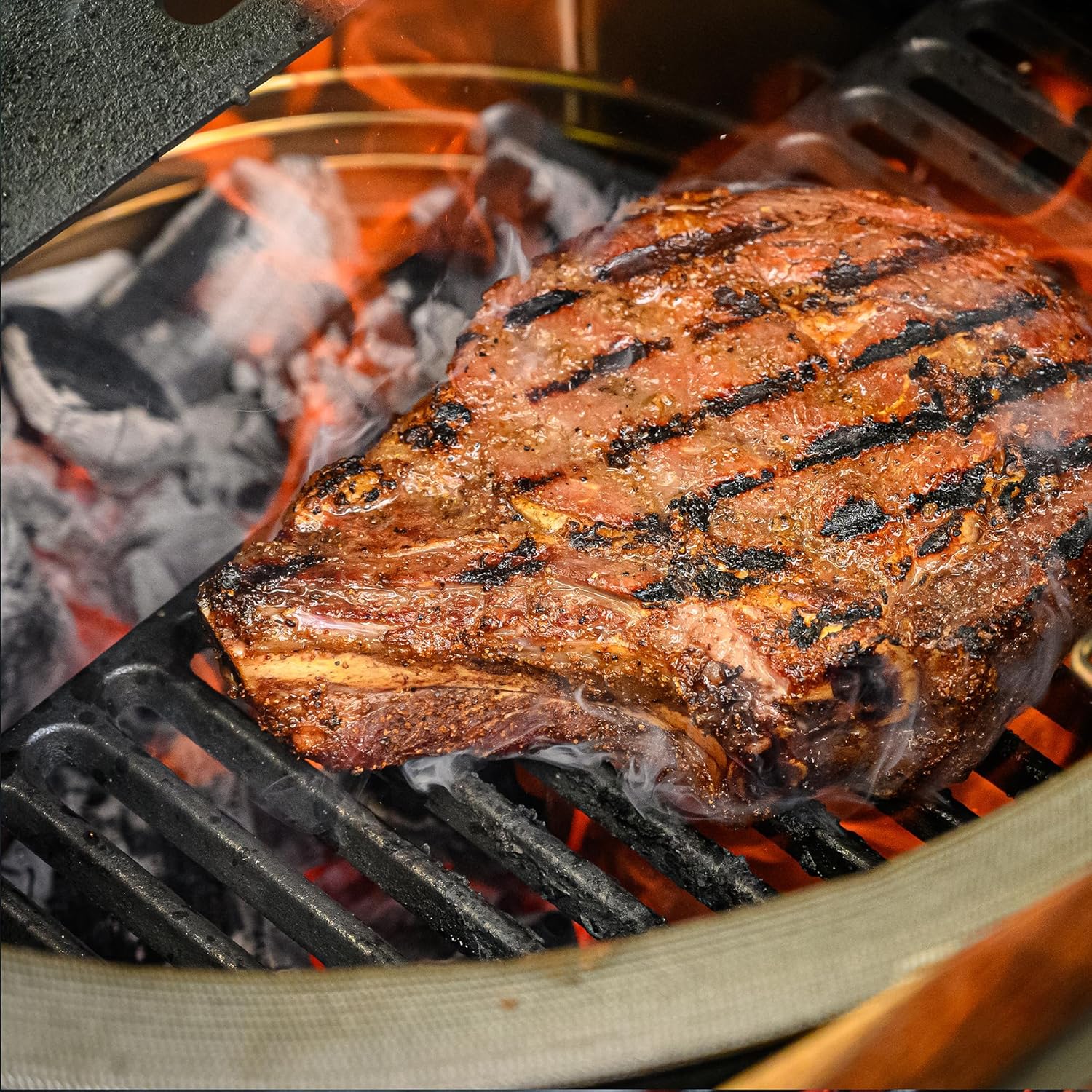
Cast iron’s thermal mass changes how heat is stored and delivered at the contact surface, enhancing sear formation and crust development for proteins while maintaining surface heat during repeated loading. In an 18-inch kamado environment, the half-moon geometry concentrates contact area and, combined with a ceramic shell, creates a stable radiant heat field. That stability benefits direct high-heat grilling and reverse-sear workflows where sustained peak surface temperatures are needed. Buyers who prioritize pronounced grill marks and Maillard reaction-driven crusts will value the grate’s capacity to hold and radiate heat; however, the same characteristics mean slower temperature transitions compared with thinner stainless alternatives.

Cast iron thermal mass: what it means for searing
Cast iron stores more heat per unit volume than thinner steel grates, producing stronger contact searing when the surface is preheated. The stored energy maintains high plate temperatures as food absorbs heat, giving denser, more consistent grill marks and faster surface browning under charcoal’s intense radiant field. In practice, the grate’s mass reduces localized cooling during frequent lid openings and multiple item loads, so searing performance remains steadier across batches. That thermal inertia also means the grate will take longer to heat up initially and to cool down after the cook.
Temperature stability versus responsiveness
High thermal inertia improves stability—surface temperatures rebound faster after placing food—but reduces responsiveness to rapid setpoint changes. In kamado systems where vent adjustments fine-tune overall chamber temperature, the cast-iron grate moderates transient swings at the cooking surface. This is beneficial for sustained searing or holding tasks, but it limits quick swings between low-and-high temperature phases. Users who need fast temperature cycling for certain recipes should anticipate slower surface response and plan preheating time accordingly.
How sear quality varies with charcoal setup
Charcoal type, bed configuration, and airflow settings interact with the grate’s heat retention. Lump charcoal or dense briquettes produce different radiant profiles; concentrated charcoal baskets beneath the half-moon surface deliver intense localized heat, favoring quick searing. Conversely, dispersed low-and-slow set-ups will rely more on radiant, lower-temperature conduction through the iron for gentle finishes. The grate performs best when paired with charcoal loads and venting strategies that deliver sustained high temperatures for searing or stable moderate heat for finishing.
Fit, compatibility, and installation considerations
Compatibility hinges on diameter, grate seating geometry, and kamado interior clearances; this half-moon grate is specified for Classic Joe 18-inch kamado grills and lists compatibility with Large Big Green Egg and other round 18-inch charcoal grills. Half-moon geometry is intended to replace one side of a full grate or to be used in combination with a complementary half or specialty surface. The included cast-iron lifting tool is specified for safe installation and removal while hot, reducing direct contact risk and facilitating position changes. Buyers should verify clearances for dome rise, accessory stacking, and any aftermarket heat deflectors to ensure the thicker iron profile does not interfere with other components.
Seating geometry and pairing with other surfaces
The half-moon shape allows for modular cook space arrangements: it can pair with a second half-moon or sit next to a heat deflector for a two-zone setup. The raised profile and rim tolerances determine whether the grate sits flush with the rest of the cooking grid; slight differences between brands or aftermarket grids can affect stability and centering. When mixing materials—such as cast iron adjacent to stainless—thermal expansion differences can influence fit during extended high-heat use, so verifying seat engagement before full-temperature cooks is recommended.
Included grate lifter and safe handling guidance
The product includes a cast-iron lifting tool specifically shaped to engage the grate and lift it when hot according to manufacturer documentation. A purpose-built lifter reduces the need for improvised tools and supports controlled removal for refueling or cleaning. Because the lifter itself is iron, handling still requires heat-resistant gloves and stable placement to avoid accidental dropping; the lifter is a tool for reducing contact but does not remove all handling risk.
Cross-compatibility with other 18-inch kamados
While listed as compatible with several 18-inch kamados, actual fit can vary by model year and aftermarket modifications. The 18 x 9 x 1 inch dimensions align with standard half-moon profiles for 18-inch domes, but grill owners should cross-check inner diameter tolerances and existing accessory stacks. Compatibility statements reflect common interchangeability among popular 18-inch round cookers, yet minor differences in grate supports or internal ring systems can require small adjustments or prevent a perfect flat seat.
Temperature control, airflow, and cooking precision
Temperature control in kamado systems is primarily driven by venting, charcoal type, and thermal mass of the shell and cooking surfaces. Adding a cast-iron half-moon grate increases cooking-surface thermal mass, influencing how heat is distributed and how quickly surface temperatures change in response to vent adjustments. Airflow management remains the user’s primary control point: precise venting yields incremental temperature changes, but the iron grate smooths rapid fluctuations. For cooks seeking fine temperature precision—smoking at low steady temps or roasting—understanding the interplay between kamado vent dynamics and the iron grate’s thermal lag is essential for recipe timing and temperature setpoint planning.

How kamado vents interact with a heavy cooking surface
Kamado vents regulate oxygen flow to the charcoal bed, which controls internal combustion rate and chamber temperature. A large thermal sink like a cast-iron grate absorbs and redistributes radiant energy from the charcoal; this moderates short-term spikes and reduces the amplitude of temperature swings at the food surface. Consequently, small vent adjustments will produce more gradual changes in surface temperature compared to lighter grates, requiring finer control or earlier intervention to shift between smoking and searing phases.
Recommended temperature ranges and control precision
The grate supports low-and-slow temperatures for smoking and very high searing temperatures favored for direct grilling. For smoking, maintain steady chamber temps in the kamado’s typical smoking window and use the grate’s heat retention to keep surface conditions uniform. For searing, allow adequate preheat to saturate the iron’s thermal mass, then use concentrated fuel layouts and full vent openings to maintain high contact temperatures. Precision is best achieved through incremental vent changes and monitoring device placement close to the food, as surface readings will lag slightly behind chamber setpoints.
Airflow and heat distribution patterns across the half-moon surface
Half-moon geometry creates a directional heat profile where the loaded side above active charcoal receives more direct radiant energy, while the open or complementary side allows cooler convective zones. This is useful for two-zone cooking: direct sear on the iron half and indirect finishing on the remaining area. Cast iron distributes heat laterally across the contact surface, evening some hotspots, but localized differences tied to charcoal placement and kamado internal baffling still occur. Intentional charcoal positioning paired with vent adjustments yields predictable zones for multi-stage cooks.
Cooking capacity, versatility, and meal planning
A half-moon surface provides a concentrated area for direct heat tasks, effectively creating a flexible cooking station when combined with other half surfaces or heat deflectors. The product’s dimensions—about 127 square inches of half-moon area—support searing of several steaks, a small batch of burgers, or finishing portions while freeing space for indirect items. Versatility arises from mixing this iron grate with other surfaces (e.g., deflectors, cast-iron griddles, or full-grid replacements) to stage searing, smoking, and indirect roasting in a compact kamado footprint. Capacity planning must account for batch sizes, desired spacing for airflow around pieces, and the heavier grate’s impact on loading cadence when swapping surfaces during service.

Direct grilling capacity and typical meal throughput
The half-moon area is sized for focused searing tasks: several steaks, a few chicken breasts, or multiple thick-cut burgers at once, depending on spacing. For larger gatherings, the grate enables a rapid sear zone to finish items while a second surface or lower rack handles ongoing batches. Throughput increases with efficient staging—searing in concentrated bursts and moving finished items to a holding area—since iron maintains searing temperatures across consecutive loads without rapid cooldown.
Smoking and combination use: strategies for hybrid cooks
For hybrid grilling-smoke workflows, the half-moon grate allows placement of a heat deflector or indirect surface opposite the iron side, creating a clear two-zone environment. Smoke-centric recipes benefit from leaving a passive zone while using the cast-iron section for occasional browning or final sears. The iron grate’s radiative contribution modifies smoke circulation patterns slightly, so positioning of drip pans and flavoring wood should factor in to avoid overly intense radiant heat near delicate items.
Surface area calculations and realistic expectations
Derived from listed dimensions, the half-moon area is approximately half the area of an 18-inch round as commonly understood for modular cooking surfaces. That creates predictable cooking real estate for focused tasks but is not a full replacement for a full-diameter grate when the objective is maximizing simultaneous item count. The half-moon’s strength is in specialized searing and modular workflows rather than mass-cooking large quantities in a single pass.
Maintenance, durability, and long-term ownership considerations
Cast iron offers long-term durability when properly seasoned and stored, but it requires consistent maintenance to prevent oxidation and preserve non-stick characteristics. The product lists iron material and includes a cast-iron lifter; both should be maintained through regular seasoning cycles, drying after cleaning, and light oiling to prevent rust. Heavy duty construction and a nearly 7-pound mass suggest longevity across many seasons if care routines are followed. However, the need for periodic re-seasoning, potential for surface pitting if left wet, and mechanical care during installation and removal are trade-offs compared with low-maintenance stainless alternatives.

Seasoning, cleaning methods, and rust prevention
Cleaning cast iron typically involves scraping residual food, brushing with a stiff brush, and applying a thin coat of oil while warm to maintain a protective seasoning layer. Abrasive scrubbing or prolonged soaking can strip seasoned layers and accelerate rust, so manufacturers and industry practice recommend dry storage and re-oiling after use. Occasional high-heat burn-offs in the kamado can help remove stubborn residue, but follow-up re-seasoning restores optimal surface properties.
Expected lifespan and failure modes
Properly maintained cast-iron cookware and grates can remain serviceable for decades; common failure modes are surface rust, cracking from extreme thermal shock, or warping from uneven heating. In a kamado setting, the ceramic shell reduces thermal shock risk relative to open grills, but owners should avoid rapid temperature swings and ensure even heating. Occasional reconditioning and attention to storage will extend functional life, with the heavy construction itself not prone to structural failure under normal use.
Ease of maintenance compared with other materials
Compared with stainless steel or porcelain-coated grates, cast iron demands more routine care but delivers superior searing characteristics and durability when maintained. Stainless options reduce hands-on maintenance and resist rust without seasoning, while porcelain coatings can chip under heavy use. Choosing cast iron is a trade-off: higher maintenance for enhanced surface performance and long-term reparability.
Pros & Cons
Pros
- Exceptional heat retention and searing capability: Solid cast iron increases thermal mass for stronger contact searing and consistent grill marks, benefiting steaks and other proteins that rely on Maillard reactions. The material radiates heat evenly across its mass, improving batch consistency during repeated loads.
- Durable construction for long-term use: Cast iron and iron components are inherently robust; with proper care, the grate and lifter are likely to remain functional for many seasons, making them a durable accessory for kamado owners.
- Modular half-moon geometry supports two-zone cooking: The half-moon shape enables pairing with other surfaces or deflectors to create direct and indirect zones, improving versatility in the compact 18-inch kamado footprint.
- Included grate lifter simplifies handling: A purpose-built lifter tool is provided to remove and reposition the hot grate safely, reducing reliance on improvised tools and improving operational control during cooks.
- Compatible with popular 18-inch kamados: Specifications indicate fit for Classic Joe and several 18-inch models, making the grate a flexible upgrade for many kamado owners.
- Good weight for thermal stability: At nearly 7 pounds, the grate’s mass helps stabilize surface temperatures under load and mitigates short-term cooling during lid openings.
Cons
- Requires regular seasoning and maintenance: Cast iron is prone to rust if not dried and seasoned properly; owners must commit to cleaning and oiling practices that some users may find burdensome compared with low-maintenance materials.
- Slower thermal responsiveness: High thermal inertia means the grate takes longer to heat and to cool, reducing responsiveness to quick temperature changes and requiring more preheat time.
- Potential fit variation across brands: Although listed as compatible with multiple 18-inch kamados, slight dimensional and support differences across models may cause fit or seating variations that require verification prior to purchase.
- Additional handling weight and care: The heavy iron grate increases the effort required for installation and removal; even with the included lifter, safe handling requires gloves and cautious technique.
Final Verdict: Who This Grill or Smoker Is Best For (and Who Should Skip It)
This half-moon cast-iron cooking grate suits charcoal-focused cooks who value top-tier searing, consistent surface heat, and modular two-zone setups within an 18-inch kamado footprint. It is well matched to Classic Joe owners and to those using similarly sized kamados who want a durable, high-mass surface for steaks, burgers, and reverse-sear workflows. The included lifter and cast-iron construction make it a solid long-term accessory for users willing to maintain seasoned surfaces and plan for preheat times that accommodate iron’s thermal mass.
Those who should skip this grate include buyers seeking low-maintenance, rapid-temperature-change setups, or owners of non-charcoal cookers such as gas, pellet, or electric grills where compatibility and material benefits do not align. Additionally, cooks who need maximum full-diameter cooking area in a single pass would be better served by a full grate solution rather than a half-moon specialty surface. Compared to similar offerings in 2026, this grate emphasizes sear-focused performance and longevity at the cost of added maintenance and slower responsiveness.
Frequently Asked Questions (FAQs)
Is the Kamado Joe half-moon cast iron grate compatible with other 18-inch kamado brands?
The grate is specified for Classic Joe 18-inch kamados and lists compatibility with several round 18-inch cookers. Fit depends on inner diameter tolerances and seating geometry; most standard 18-inch kamados accept similar half-moon profiles. Buyers should verify their model’s internal ring system and accessory clearances because slight variations in grate supports or heat deflector stacks can affect seating and stability.
How does cast iron affect cooking temperatures and responsiveness in a kamado?
Cast iron increases cooking-surface thermal mass, improving heat retention and searing consistency but reducing responsiveness to rapid temperature changes. The grate absorbs and radiates heat, smoothing short-term spikes and maintaining surface heat under load. This provides steadier searing but requires longer preheat times and more gradual vent adjustments for setpoint shifts.
What maintenance is required to keep a cast iron grate in good condition?
Regular maintenance includes scraping or brushing food debris, avoiding prolonged soaking, thoroughly drying after cleaning, and applying a thin coat of cooking oil while warm to maintain seasoning. Periodic high-heat burn-offs followed by re-seasoning restore non-stick properties. Proper storage in a dry environment prevents oxidation and extends service life.
Can this half-moon grate be used for low-and-slow smoking as well as searing?
Yes. The grate supports both smoking and searing workflows when used in a kamado. For smoking, it offers stable surface heat for finishing or occasional browning, while for searing it provides the thermal mass needed for strong contact heat. Effective hybrid use typically pairs the iron grate with a heat deflector or secondary surface to create clear direct and indirect zones.
Does the product include tools for installation and removal while hot?
The package lists an included cast-iron grate lifter tool designed to engage and lift the grate when hot. The lifter is intended to reduce improvised handling and facilitate removal for cleaning or charcoal management. Heat-resistant gloves are still recommended when using the lifter to avoid burns and ensure stable handling.
How large is the cooking surface provided by the half-moon grate?
Based on the listed 18 x 9 inch dimensions, the half-moon surface corresponds to approximately half the area of an 18-inch round grill, yielding roughly 127 square inches of cooking surface. This size is suitable for focused searing tasks, batch grilling for small gatherings, or pairing with complementary surfaces for multi-zone setups.
Will cast iron rust if left outside or exposed to moisture?
Cast iron is susceptible to oxidation when exposed to moisture or left wet; prevention relies on storage in a dry location and maintaining a seasoned oil layer after cleaning. If surface rust appears, it can be removed with brushing and re-seasoning. Continuous outdoor exposure without protective measures increases the risk of rust and reduces lifespan.
Should owners replace a full grate with this half-moon option for every cook?
A half-moon grate is a specialty accessory intended for modular workflows rather than a universal replacement. It excels for searing and staged cooking when paired with other surfaces or deflectors, but owners who require maximum simultaneous capacity may prefer a full grate. The half-moon is best used as part of a planned two-zone or hybrid cooking strategy.