KitchenAid 11.25 in Grill Pan Review — Even Heat & Induction

Why grill-pan choice matters for indoor searing
Selecting the right grill pan changes how indoor searing and stovetop grilling perform for everyday cooks and weekend entertainers. For those prioritizing steakhouse-style sears, pronounced grill marks, and quick browning, material, base thickness, and contact area matter more than decorative features. Fuel compatibility—especially induction readiness—dictates which kitchens will realize consistent heat, while oven safety expands finishing options. Maintenance expectations hinge on nonstick construction and dishwasher compatibility, and the tradeoff between easy release and high-heat tolerance should guide purchase decisions. The KitchenAid Hard Anodized Induction Nonstick Square Grill Pan targets users who need an induction-ready, oven-safe pan with a square cooking surface to maximize contact area for smaller kitchens and controlled indoor grilling tasks.
Quick Overview
| Feature | Details |
|---|---|
| Grill or smoker type | Stovetop grill pan (square) |
| Fuel type | Compatible with gas, electric, and induction stovetops |
| Total cooking area | Approximate 11.25-inch square cooking surface |
| Temperature range | Oven safe to 500°F (max) |
| Materials and construction | Hard anodized aluminum body; triple-layer nonstick interior; aluminum handle with enhanced nonstick on rivets |
| Control system | Manual stovetop heat control (no digital elements) |
| Best suited cooking styles | Indoor searing, pan grilling, finishing in oven, vegetables, sandwiches |
| Intended use cases | Home stovetop grilling and searing for small to medium portions; oven finishing |
| Warranty | Manufacturer warranty — see KitchenAid / Meyer Corporation disclosures |
The specifications point toward a compact, versatile indoor grill surface optimized for searing and grilling tasks on modern stovetops including induction. A thick, forged base and hard anodized construction prioritize even heat conduction and durability, while triple-layer nonstick simplifies release and cleanup for routine home use. Oven-safe capability to 500°F allows finishing and higher-heat techniques that extend versatility beyond stovetop-only pans.
Heat distribution and temperature control
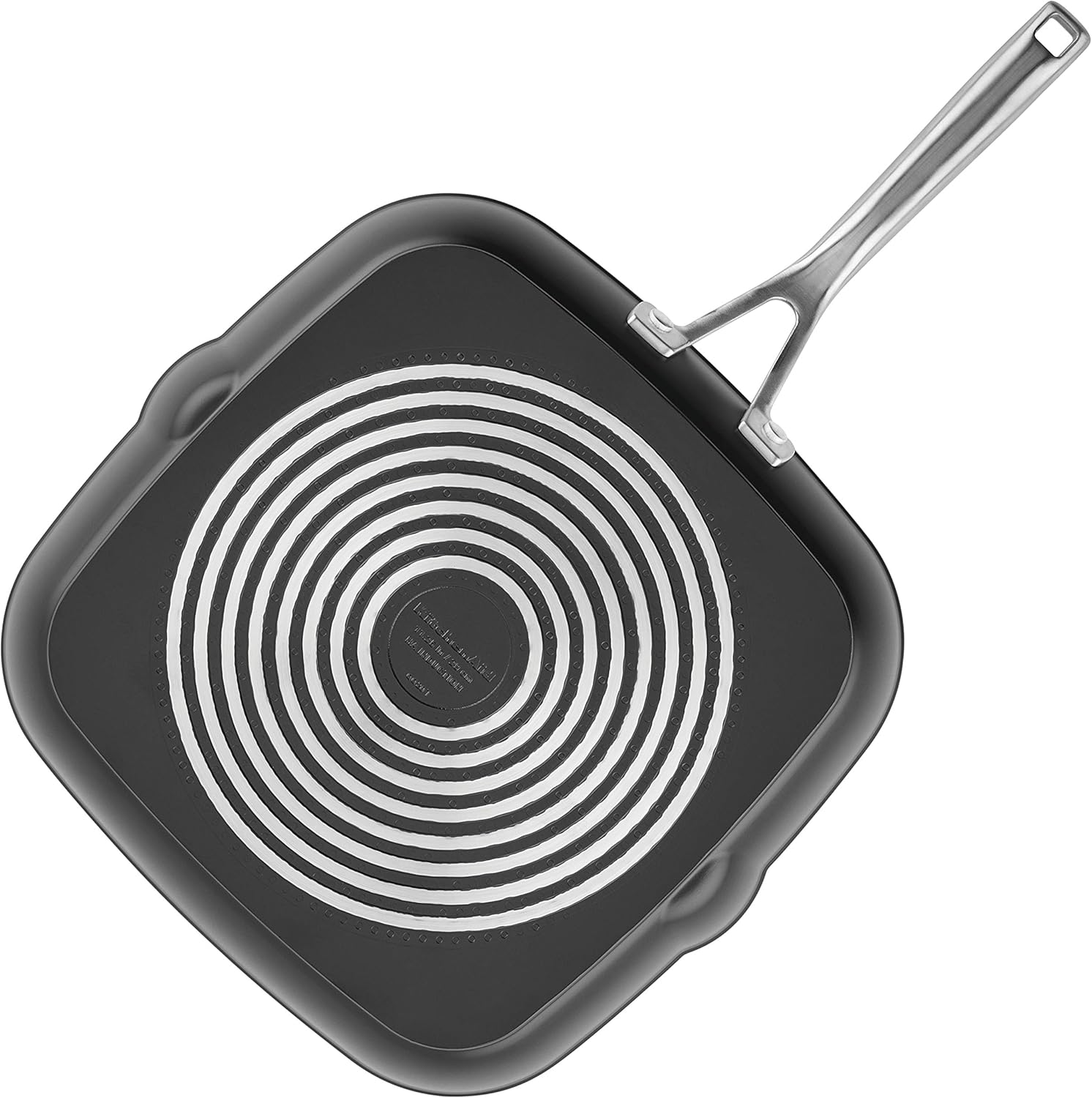
Heat distribution and controllability form primary decision drivers for stovetop grill pans, and this product emphasizes a thick, forged base to limit hot spots and promote even surface temperature across the square cooking area. Induction compatibility requires a consistent ferromagnetic contact layer or compatible base geometry; manufacturer disclosures list induction as supported, indicating the base design works with smooth-surface induction cooktops. Manual stovetop control still determines searing performance, so burner size and power influence how quickly the pan reaches target temperatures and how steady those temperatures remain under load. Oven-safe construction to 500°F extends the temperature envelope, enabling transitions from high direct sear to moderate oven finishing without transferring food to separate cookware.

Base thickness, thermal mass, and searing results
Thick, forged bases increase thermal mass and help the pan resist temperature dips when cold proteins contact the surface; higher thermal mass also evens temperature across the ridged surface to reduce extreme hot and cold spots. In practice, pans with a substantial forged base hold heat better during searing, which supports consistent Maillard reaction and grill-mark formation. However, thicker bases take longer to heat initially and rely on adequate burner output—particularly on induction, where matched burner size optimizes energy transfer. The KitchenAid pan’s construction suggests a balance between heat retention and induction responsiveness that favors controlled sears on appropriately sized burners.
Temperature control on different stovetops
Manual heat control is the default method for stovetop searing with this pan; gas allows rapid power modulation and visible flame adjustments, electric radiants show slower responsiveness, and induction provides fast, even heating with precise setpoints on compatible cooktops. Induction compatibility in the manufacturer specifications means the pan can capitalize on induction’s quick temperature changes and steady simmering ability, while oven safety to 500°F supports finishing methods that require stable, closed-environment temperatures. Users should match burner dimensions to the pan base for optimal control and avoid prolonged empty-pan high-heat exposure that can stress nonstick surfaces.
Oven finishing and high-temperature considerations
Oven-safe ratings to 500°F permit finishing thicker cuts, melting finishes, and carrying out higher-heat techniques after initial stovetop searing. Hard anodized aluminum maintains structural integrity at oven temperatures typically encountered in residential kitchens, but the triple-layer nonstick interior and riveted handle components require adherence to manufacturer temperature limits to avoid coating degradation. While oven finishing delivers even internal cook times, repeated high-temperature use may accelerate wear on nonstick surfaces compared with lower-temperature routines. Staying within the stated maximum temperature protects the coating and prolongs effective release characteristics.
Cooking capacity and surface functionality
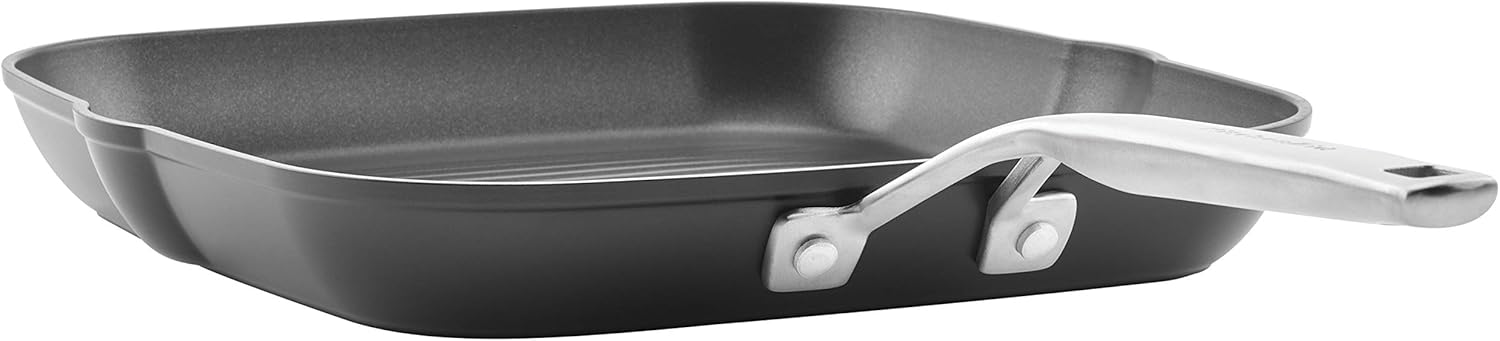
Cooking capacity is a practical constraint for household users evaluating square grill pans. Surface dimensions determine how many protein portions or companion vegetables can be seared in a single batch; an 11.25-inch square surface yields more usable flat contact area than a similar-diameter round pan, enabling efficient arrangement of steaks, chops, or multiple smaller items. Ridge geometry affects fat drainage, smoke generation, and grill-mark quality; raised ridges create separation between food and rendered fats, concentrate heat contact on ridge lines for pronounced charring, and guide juices toward edges and pouring spouts. For multi-course home preparation, the pan’s square footprint and pouring spouts enhance workflow by accommodating moderate portion sizes while reducing center crowding that can steam items instead of searing.

Square shape vs. round pans for portioning and contact
Square grill pans maximize usable cooking surface compared with round equivalents of similar external dimensions, which benefits users needing to fit rectangular items like fish fillets or multiple burgers side by side. The geometry reduces unused corner space and supports more efficient layout for batch searing multiple small portions. However, larger single cuts that require long, continuous surface contact may still be better suited to larger plancha-style surfaces or outdoor grills. For typical household servings, the KitchenAid 11.25-inch square surface balances compact storage and increased usable area for everyday searing and grilling tasks.
Ridge design, grill marks, and juice management
Ridges deliver classic grill marks by concentrating contact pressure and heat along narrow lines, which accelerates localized Maillard reaction. They also elevate food above pooled fats, reducing shallow-fry conditions and channeling juices toward troughs and the pan’s pouring spouts for easier fat removal. Ridge height and spacing influence how much surface remains in contact versus elevated; taller, well-spaced ridges produce more pronounced marks and separation but reduce total flat contact. The presence of pouring spouts is practical for removing rendered liquids without tipping the pan, making it easier to manage flare-prone residues when finishing in an oven or transferring to a serving plate.
Portion planning and kitchen workflow
Capacity decisions should reflect typical meal patterns and the kitchen’s workflow: households regularly searing multiple steaks or large roasts will find the 11.25-inch square surface limiting, whereas couples or small families benefit from the compact but efficient area. The pan’s light weight aids handling when transferring to an oven, and the square shape works well on rectangular burners and in oven racks. For cooks who batch-cook or prefer to maintain high ambient kitchen heat, staging food and using multiple pans or an outdoor grill may be preferred; for stovetop-only indoor searing and finishing, the pan’s footprint supports efficient single-pan workflows.
Materials, durability, and maintenance
Material choice and construction details predict long-term behavior under repeated use. Hard anodized aluminum offers enhanced surface hardness and corrosion resistance compared with raw aluminum; the anodization process forms a denser oxide layer that reduces surface scratching and provides a stable substrate for nonstick coatings. Triple-layer nonstick interiors improve release and reduce the need for added fats during cooking, but nonstick longevity depends on abrasive contact, cleaning methods, and exposure to high temperatures. Handle construction using aluminum and rivets increases mechanical strength, while the manufacturer’s note that rivets are finished with enhanced nonstick indicates attention to seamless food release around attachment points. Dishwasher-safe claims streamline cleanup, though mild detergents and non-abrasive tools preserve coating life better than repeated machine washing.

Hard anodized aluminum: strengths and limitations
Hard anodized aluminum is harder and more wear-resistant than untreated aluminum, offering improved scratch resistance and thermal conduction. The dense oxide layer resists pitting and chemical attack under normal culinary conditions, and the material remains relatively lightweight compared with steel or cast iron. Limitations include potential vulnerability at edges where anodization may be thinner and the need for careful care of nonstick surfaces applied over the anodized layer. For users seeking a balance of performance, weight, and corrosion resistance, anodized aluminum often strikes an appealing middle ground.
Triple-layer nonstick properties and care recommendations
Triple-layer nonstick systems provide more robust release than single-layer finishes and typically include a primer coat, mid-layer, and topcoat engineered for abrasion resistance and prolonged slip. These coatings reduce food adhesion and simplify cleanup, but their effective lifespan depends on utensil choice, heat exposure, and cleaning method. The manufacturer’s dishwasher-safe designation offers convenience, yet handwashing with a soft sponge and avoiding metallic utensils or high-heat dry-pan exposure will prolong effective release. Observed customer patterns for similar products often cite gradual reduction in slipperiness after extended heavy use rather than sudden failure.
Rivet and handle design impact on longevity
Riveted handles provide a durable mechanical connection between handle and pan body, and finishing rivets with nonstick coverage reduces food entrapment and cleaning friction around attachment points. Aluminum handles are lightweight and conduct heat; at oven temperatures, they remain structurally stable but will transfer heat faster than insulated composite handles. The pan’s oven-safe rating confirms handle integrity under stated conditions, but users should employ oven mitts or protective gear when retrieving pans from high-temperature environments to avoid contact burns. Over time, rivet areas can be collection points for grease buildup if not cleaned thoroughly, so periodic attention supports long-term hygiene and appearance.
Cooking versatility and fuel compatibility
Versatility hinges on stovetop compatibility, oven safety, and suitability for varied cooking styles. Manufacturer disclosures list compatibility with gas, electric, and induction cooktops, enabling use across most kitchen setups; induction-ready designs rely on conductive base elements that couple efficiently with magnetic cooktops. Oven safety to 500°F expands techniques to include finishing, broiling-adjacent sears, and controlled roasts for thin cuts. However, product design as a stovetop grill pan limits use for true smoking or charcoal grilling; smoke flavor development is possible to a degree with aromatic additives, but it will not replicate the prolonged low-and-slow smoke infusion produced by dedicated smokers or outdoor charcoal units.

Induction, gas, and electric stovetop differences
Induction offers rapid, precise heat control and consistent temperature maintenance which benefits searing and simmering alike; gas provides real-time visual flame adjustments and can produce strong localized heat when needed for initial high-heat searing; electric coil or radiant elements heat more slowly and may create uneven heat if burner and pan diameters mismatch. Given the pan’s induction compatibility, users with induction cooktops can expect efficient energy transfer and quicker ramp times compared with electric radiants. For best results across all stovetops, matching burner size and ensuring full contact between pan base and heat source improves evenness and responsiveness.
Indoor searing vs. smoking and outdoor grilling
The pan is engineered for direct-contact searing and indoor grilling rather than smoking or open-flame grilling. While smoke-like flavors can be coaxed in limited amounts from aromatic oils or brief exposure to smoking agents, extended low-temperature smoking requires controlled airflow and smoke generation that stovetop pans do not provide. Outdoor grilling and smoking appliances manage airflow, combustion, and smoke retention for low-and-slow infusion—capabilities beyond this pan’s intended design. For cooks seeking authentic smoked profiles, dedicated smokers, pellet grills, or charcoal systems remain the appropriate choice.
Use cases enabled by oven safety and stovetop compatibility
Oven safety and stovetop compatibility enable multi-stage cooking: initial high-heat searing on induction or gas, followed by transfer to an oven to finish internal temperature without overbrowning. This is useful for thicker steaks, pan-seared fish followed by gentle oven finishing, or gratin-style bakes where the ridged base imparts texture while oven heat completes cooking. The pan suits kitchens that prefer indoor searing and finished plating without moving food to separate sheet pans, streamlining the cooking sequence for small to medium portions.

Pros & Cons
Pros
- Even heat conduction from a thick, forged base improves heat retention and reduces hot spots, supporting consistent searing and grill marks across the square surface. This construction benefits induction and gas stovetops when burner size is appropriately matched.
- Induction compatibility expands usability to modern cooktops, allowing rapid temperature changes and precise heat control that enhance both searing and simmering tasks. Users with induction ranges will see faster ramp times than with standard electric units.
- Triple-layer nonstick interior and enhanced nonstick on handle rivets provide strong food release and simplified cleanup for everyday cooking, reducing the need for excess oil and easing plate transfer.
- Hard anodized aluminum construction balances durability, corrosion resistance, and weight, offering a robust substrate that withstands normal kitchen use without the heft of cast iron.
- Oven-safe to 500°F allows multi-stage cooking techniques, enabling stovetop sear followed by oven finishing without transferring food to different pans for many common recipes.
- Square 11.25-inch footprint increases usable cooking area compared with round pans of similar external dimensions, supporting more efficient portion arrangement for household meals.
- Pouring spouts help drain rendered fats and liquids cleanly, improving grease management and simplifying transitions between stovetop and oven stages.
- Dishwasher-safe designation simplifies maintenance for users prioritizing convenience, while handwashing remains the preferred route for maximizing nonstick longevity.
Cons
- Nonstick coatings will gradually lose peak release properties with heavy use, exposure to high heat, or abrasive cleaning, so performance may decline over an extended period compared with bare metal surfaces.
- The compact 11.25-inch square surface limits batch capacity for larger families or cooks who frequently sear many large cuts at once; larger planchas or outdoor grills may be required for higher-volume needs.
- Handle material and rivets conduct heat; while oven-safe, handles will become hot at elevated temperatures and require mitts for safe handling, which adds a handling consideration during oven transfers.
- While dishwasher-safe, repeated dishwasher cycles can accelerate wear on nonstick surfaces compared with gentle handwashing, affecting the long-term appearance and release characteristics.
Final Verdict: Who This Grill or Smoker Is Best For (and Who Should Skip It)
The KitchenAid Hard Anodized Induction Nonstick Square Grill Pan suits home cooks seeking an induction-ready, oven-safe stovetop grill pan that prioritizes even heat, nonstick release, and a compact yet efficient cooking footprint. It is well matched to individuals or small households who want reliable searing performance, clear grill marks, and straightforward cleanup, plus the flexibility to finish dishes in an oven up to 500°F. The square shape maximizes usable surface area for portioning multiple smaller items and fits modern kitchen workflows where induction compatibility and light-weight handling are priorities.
This pan is less appropriate for cooks who require high-capacity batch grilling, long low-and-slow smoking, or the extreme surface durability of bare-metal surfaces for repeated high-heat deglazing and metal-utensil use. Users who frequently perform heavy-duty searing at sustained top-tier temperatures or who rely on prolonged exposure to abrasive cleaning may prefer cast iron or stainless steel options. For its target profile—everyday indoor searing, stovetop-to-oven finishing, and induction-equipped kitchens—the pan delivers a balanced combination of heat management, release performance, and convenience when cared for according to manufacturer guidelines.
Frequently Asked Questions (FAQs)
Is this KitchenAid grill pan compatible with induction cooktops?
Yes. Manufacturer specifications list the pan as induction compatible, meaning the base construction is suitable for smooth-surface induction cooktops. Induction operation provides rapid ramp-up and precise temperature control, but best performance occurs when burner size and pan base are well matched to ensure full contact and stable heat transfer.
Can the pan be used in the oven and to what temperature?
The pan is rated oven-safe to 500°F according to product disclosures. This enables finishing seared items in an oven set at or below that temperature. Users should follow manufacturer recommendations on preheating and avoid exposing the nonstick coating to temperatures above the stated maximum to protect coating longevity.
How does the hard anodized construction affect durability and cooking?
Hard anodized aluminum provides a harder, more wear-resistant surface than untreated aluminum and improves corrosion resistance while remaining relatively lightweight. It offers good thermal conductivity for even heating, but nonstick coatings applied over the anodized layer require careful handling to avoid abrasive damage and prolonged high-heat exposure.
Is the triple-layer nonstick safe and long-lasting?
Triple-layer nonstick systems offer improved release and abrasion resistance compared with single-layer coatings, easing food release and cleanup. Longevity depends on care: avoid metal utensils, abrasive cleaners, and frequent empty-pan overheating. While dishwasher-safe, handwashing with mild detergent and a soft sponge will better preserve nonstick properties over time.
Can this grill pan replace outdoor grilling or smoking equipment?
The pan is designed for indoor stovetop grilling and searing rather than outdoor smoking or open-flame grilling. While it can create grill marks and concentrated sear, it cannot reproduce prolonged low-and-slow smoke infusion or the airflow control of dedicated smokers or charcoal grills. For authentic smoked flavors, a dedicated smoker or outdoor grill is recommended.
How much cooking surface does the 11.25-inch square provide for portion planning?
An 11.25-inch square cooking area provides an efficient rectangular footprint that typically accommodates multiple small to medium portions—such as two steaks or several burgers—without crowding. Square geometry increases usable contact area compared with many round pans of similar external size, aiding portion layout for household meal prep.
Is the pan suitable for high-heat searing without damaging the nonstick coating?
The pan’s thick forged base supports high-heat searing, and the oven-safe rating to 500°F allows elevated-temperature finishing. However, repeated prolonged exposure to very high dry-heat and empty-pan heating can accelerate nonstick wear. To maximize coating life, preheat carefully, avoid sustained empty-pan high-heat, and use appropriate utensils and cleaning methods.