EIHO ESWMT-2 Review: Wireless Thermometer for Grilling 2026
Why thermometer selection matters for consistent grilling and smoking
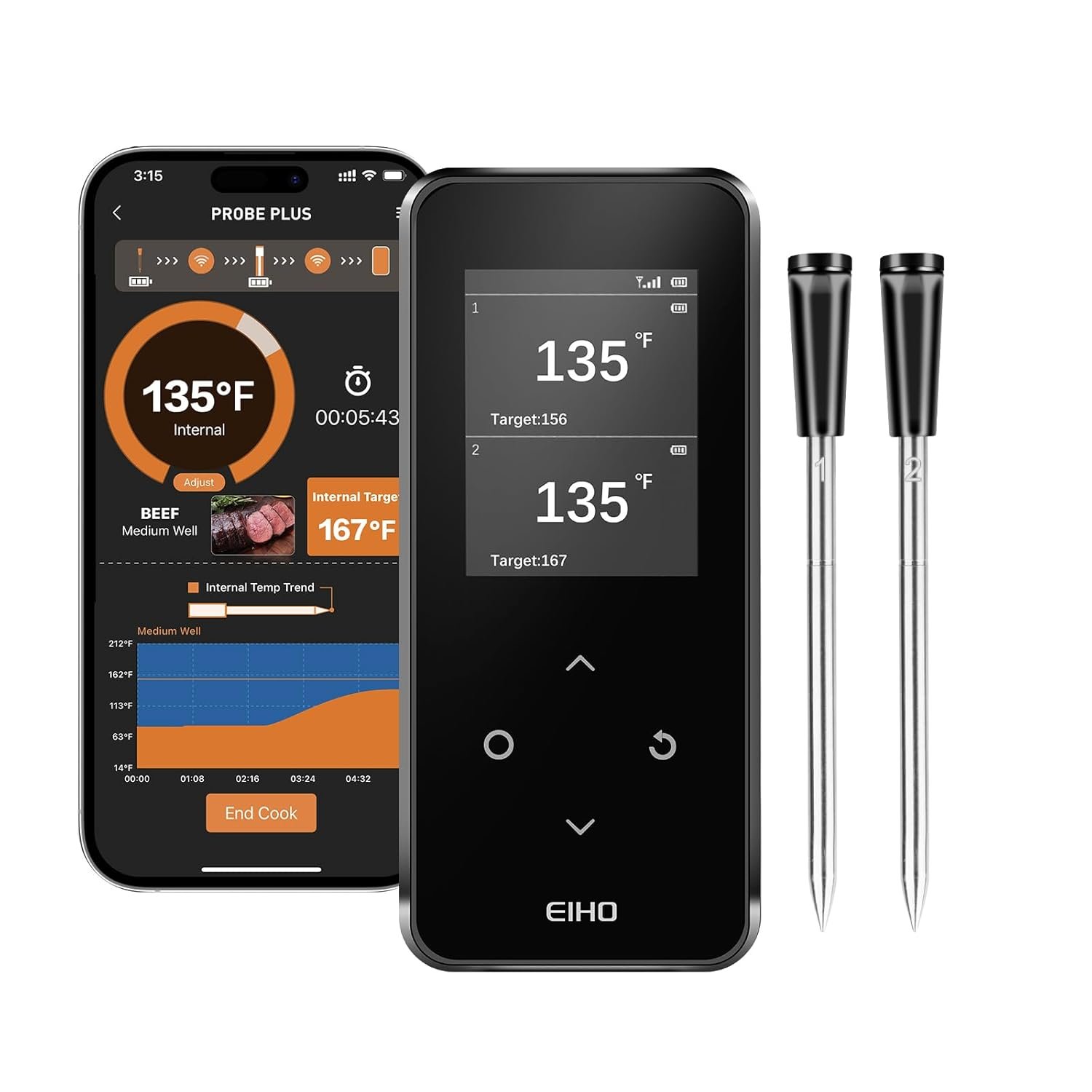
Choosing the right meat thermometer is central to predictable outdoor cooking outcomes because temperature control, probe reliability, and alerting behavior determine doneness and food safety. For backyard grillers, pitmasters adapting to smoking, and home cooks using ovens or air fryers, a thermometer must match the heat profiles of different fuel types and cooking methods. The EIHO ESWMT-2 positions itself as a wireless digital option with a large LED base display, app control, a magnetic mounting bar, and stainless steel probes—features that address remote monitoring, durability, and cross-platform compatibility. Buyers should prioritize probe operating limits, accuracy tolerance, battery life, and how the device integrates into existing workflows. The ESWMT-2’s specification set—±1℃ accuracy, specified probe temperature limits, and claimed multi-hour run times—lends itself to cooks seeking repeatable internal-temperature monitoring rather than those who need integrated grill temperature control or multi-zone pit management. Understanding how those specifications translate into real heat-management practices across gas, charcoal, pellet, and electric setups helps determine fit for purpose.
Quick Overview
| Feature | Details |
|---|---|
| Product type | Wireless digital meat thermometer (probe + smart base) |
| Fuel compatibility | Compatible with gas, charcoal, pellet grills, electric grills, ovens, air fryers |
| Temperature monitoring range | Lower rating 14°F; probe accuracy ±1℃ (±1.8°F); probe max resist 212°F; probe handle max 572°F |
| Materials & construction | Stainless steel probes; plastic smart base with large LED display; magnetic back bar |
| Control & connectivity | Local LED display, wireless probe transmission, optional smart app with presets and alerts |
| Power & runtime | Smart base >30 hours per full charge; probes 18+ hours per charge (manufacturer claim) |
| Intended cooking styles | Grilling, smoking, roasting, air frying, oven use |
| Best use cases | Home cooks wanting remote monitoring and preset alerts |
| Warranty | Not specified in available product specifications |
The table above maps core specifications to practical use: the ESWMT-2 emphasizes remote internal-temperature tracking with a large base display and wireless notification features, while stainless steel probes and a magnetic mounting option support outdoor attachment. The specified probe temperature limits and accuracy determine which cuts and techniques are appropriate, and the optional app broadens monitoring flexibility for cooks who need alerts away from the grill.

Temperature accuracy and control precision
The ESWMT-2’s stated ±1℃ (±1.8°F) accuracy positions it within typical consumer-grade digital thermometer tolerances, which is generally sufficient for achieving target doneness for beef, pork, poultry, and fish. Accuracy interacts with probe placement and thermal gradients: correct insertion depth and sampling away from bone or fat pockets produce the most reliable readings. Probe response time and reporting cadence—real-time synchronization to the base and app—are important for tracking temperature trends, though specification sheets do not disclose sampling frequency. The max probe resistance rating (212°F) and probe-handle tolerance (572°F) create a two-part operating envelope that affects direct-placement options; cooks should consider these limits relative to searing and smoker grate temperatures. For precision-focused users, probe calibration checks against an ice bath or boiling-point verification can validate the device’s accuracy against local barometric conditions.

Probe specifications, limits, and placement
The ESWMT-2 includes stainless steel probe construction with a declared maximum resistant temperature of 212°F for the probe tip and a handle tolerance rated to 572°F. Stainless steel is corrosion resistant and conductive for reliable thermal transfer, but the probe tip’s rated maximum suggests it is optimized for internal-readings rather than direct exposure to open flame or extreme surface searing. Proper placement—center of the thickest portion of meat, away from bone or gristle—reduces error introduced by thermal gradients. The stated lower temperature rating of 14°F supports measurements for refrigerated meat temperature checks and slow smoking, while the ±1℃ accuracy denotes predictable variance for doneness thresholds when probes are used consistently.
Digital control, notifications, and data sync behavior
A large LED smart base provides local, at-grill readout and alerting without mandatory smartphone use; the manufacturer notes synchronization of alerts with a phone when the goal is reached. The optional smart app offers preset targets, timers, temperature trend charts, toggle between °F/°C, and ringtone/vibration controls, enabling remote monitoring workflows. Although specifications state real-time tracking and synchronization, they do not list the wireless protocol or maximum transmission range; typical consumer wireless thermometers use Bluetooth with line-of-sight ranges between 30–100 feet or Wi-Fi bridging via base stations. Users should consider signal path, obstacles, and app requirements even though the base can operate independently.
Cooking style suitability and fuel-type compatibility
Choosing a thermometer depends on whether grilling, low-and-slow smoking, or combination cooking is the primary focus. The ESWMT-2 is designed for internal temperature monitoring across various cooking platforms—gas grills, charcoal, pellet smokers, electric grills, ovens, and air fryers—rather than ambient chamber control. The probe-based readings directly measure meat core temperature but do not control burner or fan behavior. For high-heat searing on gas or charcoal, probe tip temperature limits should be considered to avoid direct flame exposure; for long smoking sessions on pellets or charcoal, the battery runtime claims and probe durability matter for continuous monitoring over many hours. Compatibility with ovens and air fryers also expands use cases to indoor roasting and smaller electric appliances where remote monitoring and preset alerts save attention cycles.

Grilling versus smoking workflows
For high-heat searing on gas or charcoal grills, the ESWMT-2 can monitor internal doneness but the probe tip’s rated resistance to 212°F implies the probe is not intended for prolonged contact with grate or direct flame. In contrast, smoking and low-and-slow applications typically occur at lower ambient temperatures and focus on gradual internal development, a scenario where the thermometer’s accuracy and extended probe battery life are more advantageous. Smoke sessions often require monitoring for several hours; the base and probes’ stated run times (30+ hours base, 18+ hours probes) are aligned with multi-hour smoke sessions, provided wireless range remains stable and probes are positioned to avoid direct coal or flame contact.
Compatibility with fuel types and appliances
The ESWMT-2’s stated compatibility with gas, charcoal, pellet grills, electric grills, ovens, and air fryers makes it versatile across fuel types. For pellet smokers and electric grills that maintain steadier chamber temperatures, internal probe readings closely mirror desired doneness targets. For charcoal and direct-flame gas cooking, thermal variability and hot spots make probe placement and sampling strategy more critical, and probe thermal limits should be respected. With indoor appliances like ovens and air fryers, the probe’s lower temperature rating and cable routing will be factors; the device’s dustproof storage case also supports portability between outdoor and indoor appliances.
Durability, materials, and maintenance considerations
Durability expectations derive from materials, construction, and stated component tolerances. The ESWMT-2 lists stainless steel outer materials for probes and a plastic smart base; stainless steel probes offer standard resistance to food acids and high temperatures, while the base’s magnetic bar and LED display support outdoor attachment and readout. The device’s dustproof case and reusable design suggest portability and storage protection. Maintenance considerations include probe cleaning—specification advises water cleaning—and the implications of the probe’s stated maximum resistant temperature; continuous exposure to grill flames or extremely high surface temps could accelerate wear. Battery recharge cycles, waterproofing of the base (not specified), and cable strain points are also relevant; expected lifespan depends on usage patterns, charging habits, and environmental exposure such as salt air or frequent outdoor storage.

Construction materials and environmental tolerance
Stainless steel probe shafts are typical for corrosion resistance and thermal responsiveness, providing steady conduction from meat core to sensor. The smart base uses a display and wireless electronics that are normally housed in molded plastic; however, manufacturer specifications do not list IP ingress protection ratings, which leaves environmental tolerance unspecified. The magnetic mounting bar provides convenience for attachment to steel grill surfaces, but reliance on magnetic mounting means the base should be positioned where direct heat and weather exposure are minimized. The probe-handle temperature rating to 572°F indicates the cable-termination zone and handle materials withstand high external heat exposure, while the probe tip rating defines safe immersion limits.
Cleaning, storage, and expected maintenance schedule
Probe cleaning is achievable with water and mild detergent due to stainless steel construction; the specification explicitly states probe cleaning with water after use. The included dustproof storage case supports organized storage and protection of electronics and probes between sessions. For longevity, drying probes and connectors thoroughly before storage reduces corrosion risk, and avoiding cable kinks at the handle junction limits sensor fatigue. Rechargeable batteries in the base and probes will experience cycle-related capacity decline over months to years; following manufacturer charging guidance and avoiding extreme temperature storage will extend expected service life.
Usability, workflow integration, and multi-probe monitoring
Ease of use covers display legibility, mounting options, app interface, and the ability to monitor multiple probes reliably. The ESWMT-2’s large LED display on the smart base facilitates at-grill monitoring without a phone, while wireless synchronization to a phone and app presets add remote oversight. The magnetic back bar allows attachment to steel grill bodies for a compact workflow. The device’s stated probe runtime (18+ hours) and base runtime (>30 hours) are tailored to longer cooks, but exact multi-probe capacity, wireless protocol, and simultaneous-channel performance are not detailed in available specifications. For cooks who rely on monitoring multiple cuts or zones, knowing the maximum supported probes and update frequency is essential for mapping to complex cooks.

Display, mounting, and at-grill ergonomics
A large LED display provides immediate at-grill feedback for cooks who prefer visual confirmation without smartphone dependence; the magnetic back bar enhances placement convenience. Display contrast, digit size, and night visibility matter for early-morning smoke sessions, and the ESWMT-2’s design intent addresses those needs with a sizeable readout. The included dustproof case aids transport between indoor and outdoor appliances. However, the lack of explicit IP rating and unspecified display backlighting levels require users to consider sheltering the base during inclement weather and confirming readability under direct sunlight.
Multi-probe setup, simultaneous monitoring, and data trends
The ESWMT-2 advertises real-time tracking, preset temperatures, timers, and temperature trend charts within the app. These features are valuable for cooks who need to manage multiple probes across different cuts or to monitor ambient grill chamber development indirectly. The specifications, however, do not disclose the maximum number of probes supported or the sampling interval for trend charts. In practice, users should verify the probe-channel capacity and whether the app presents all channels concurrently with clear labels for distinct meat types to ensure effective multi-item management.
Limitations in workflow for professional or multi-zone pit use
This product is positioned for home cooks and backyard enthusiasts rather than commercial kitchens or advanced pitmasters who require integrated ambient control, multi-zone grill management, or wired thermocouples rated for constant direct-heat exposure. The probe tip and handle temperature limits, unspecified wireless range, and lack of ambient/grate probe durability data indicate limitations when used on large offset smokers, multi-zone pellets, or professional charbroilers that exceed the device’s rated exposure. Users requiring integrated grill control or long-distance real-time monitoring across property boundaries should evaluate dedicated Wi-Fi-enabled systems and ruggedized thermocouples.

Pros & Cons
Pros
- Intuitive local display and remote alerts: The large LED smart base gives immediate at-grill readouts while optional app synchronization provides remote notifications and trend charts, enabling flexible monitoring without mandatory smartphone dependence.
- Competitive stated accuracy: A declared ±1℃ (±1.8°F) accuracy aligns with typical consumer expectations for internal temperature monitoring of meats, supporting consistent doneness when probes are placed correctly.
- Cross-platform compatibility: Specifications list compatibility with gas, charcoal, pellet grills, electric grills, ovens, and air fryers, making the thermometer suitable for a wide range of cooking appliances and techniques.
- Battery runtime claims for extended cooks: Manufacturer-stated run times—more than 30 hours for the smart base and 18+ hours for probes—are compatible with multi-hour smoking sessions when used as directed.
- Stainless steel probes and dustproof case: Durable probe construction and the inclusion of a dustproof storage design support portability and protection between uses.
- Magnetic mounting and ergonomic design: A magnetic back bar allows the base to attach to steel grill surfaces for convenient placement and hands-free viewing at the cook station.
- Presets and app features: The smart app provides meat presets, timers, trend charts, and alert customization, which aids in standardized cooking processes and repeatable results.
Cons
- Ambiguous probe temperature rating: The stated probe tip maximum of 212°F suggests limitations for direct surface or high-heat contact, which may be inadequate during prolonged searing or direct-grate placement.
- Unspecified wireless range and protocol: Manufacturer specifications do not disclose whether communication uses Bluetooth or another protocol or the effective range, leaving signal reliability under variable outdoor conditions unclear.
- Lack of environmental protection rating: No IP ingress protection is specified for the smart base, which introduces uncertainty about rain, splash, and heavy outdoor exposure durability.
- Limited published technical detail on multi-probe capacity: The maximum number of supported probes and sampling interval for trend reporting are not specified, making suitability for complex, multi-zone cooks uncertain.
- Warranty information not disclosed: Product documentation available in the public specs does not list a manufacturer warranty, which is a consideration for long-term ownership expectations.
Final Verdict: Who This Thermometer Is Best For (and Who Should Skip It)
The EIHO ESWMT-2 suits home cooks and backyard grillers who prioritize internal temperature accuracy, remote alerting, and cross-device compatibility for ovens, grills, and air fryers. Its ±1℃ accuracy, stainless steel probes, large LED base, and app presets support repeatable doneness in grilling and smoking environments that avoid direct probe exposure to open flame or extreme grate surfaces. The claimed runtime capacities and dustproof case make it a practical choice for extended smoke sessions when used within the stated temperature tolerances and with careful probe placement.
This thermometer is less appropriate for professional pitmasters, commercial kitchens, or users who need ambient/grate thermocouples rated for constant direct heat and integrated grill-control systems. Those who require long-distance monitoring across a property, explicit IP-rated weatherproofing, or documented warranty coverage should consider industrial or Wi-Fi-enabled alternatives with ruggedized probes and clear environmental specifications. Overall, the ESWMT-2 offers a balanced set of consumer-focused features for internal-temperature monitoring in diverse home cooking scenarios when used in accordance with manufacturer-stated limits.

Frequently Asked Questions (FAQs)
How accurate is the EIHO ESWMT-2 meat thermometer for determining doneness?
The EIHO ESWMT-2 is specified with ±1℃ (±1.8°F) accuracy, which falls within typical consumer-grade thermometer tolerances. Accuracy is sufficient for determining safe and preferred doneness when probes are placed correctly in the thickest portion of meat and away from bone or fat. For verification, users can perform an ice-water or boiling-point check to confirm calibration under local conditions.
Can the ESWMT-2 probes be used during high-heat searing on a gas or charcoal grill?
The product lists a probe tip resistance of up to 212°F and a probe-handle tolerance up to 572°F, indicating the probes are optimized for internal temperature measurement rather than direct prolonged contact with open flames or hot grates. During high-heat searing, it is advisable to avoid direct flame contact with the probe tip to prevent exceeding the specified probe tip temperature rating.
Is the EIHO ESWMT-2 suitable for long smoking sessions on a pellet smoker?
Manufacturer claims indicate the smart base can last more than 30 hours and probes 18+ hours on a full charge, which aligns with many long smoke sessions. The thermometer’s internal monitoring and app trend charts support extended cooks, provided the probe cable and wireless connection remain stable and the probes are positioned to avoid direct contact with embers or extreme radiant heat.
Does the ESWMT-2 work without a smartphone or app?
Yes. The ESWMT-2 includes a large LED smart base that provides local readout and alerts, enabling at-grill monitoring without mandatory smartphone use. The optional app adds remote alerts, presets, and trend charts for cooks who prefer phone-based monitoring, but the base alone supplies core temperature display and alarm functionality.
How should the ESWMT-2 probes be cleaned and stored?
Probes are stainless steel and are specified to be cleaned with water after use. Thorough drying before storage reduces corrosion risk. The included dustproof case supports organized storage of probes and the base; avoiding harsh abrasives and ensuring connectors are dry will preserve performance over time.
Is the EIHO ESWMT-2 weatherproof for outdoor use?
Public specifications do not list an IP ingress protection rating for the smart base, so explicit weatherproofing is not confirmed. While the magnetic mounting and design support outdoor attachment, users should protect the base from heavy rain and prolonged direct exposure to the elements to avoid potential damage to the electronics.
How many probes can the ESWMT-2 support at once for multi-item cooking?
Manufacturer specifications do not explicitly state the maximum number of probes supported or the simultaneous monitoring capacity. The app includes features for multiple preset meat types and trend charts, but cooks requiring guaranteed multi-probe channel counts or rapid sampling rates should verify probe capacity in product documentation or seek systems with clearly stated probe limits.
Who should avoid buying the ESWMT-2 thermometer?
This thermometer is not recommended for professional pitmasters, commercial kitchens, or users who need ambient/grate thermocouples rated for continuous direct heat exposure, integrated grill control, or long-range property-wide monitoring. Those needing IP-rated weatherproof electronics or documented warranty coverage should consider industrial-grade or Wi-Fi-enabled alternatives with ruggedized sensors.