XHJ Q2 Indoor Electric Grill Review — Versatile 4-in-1 for Home
Choosing an indoor electric grill for home cooking
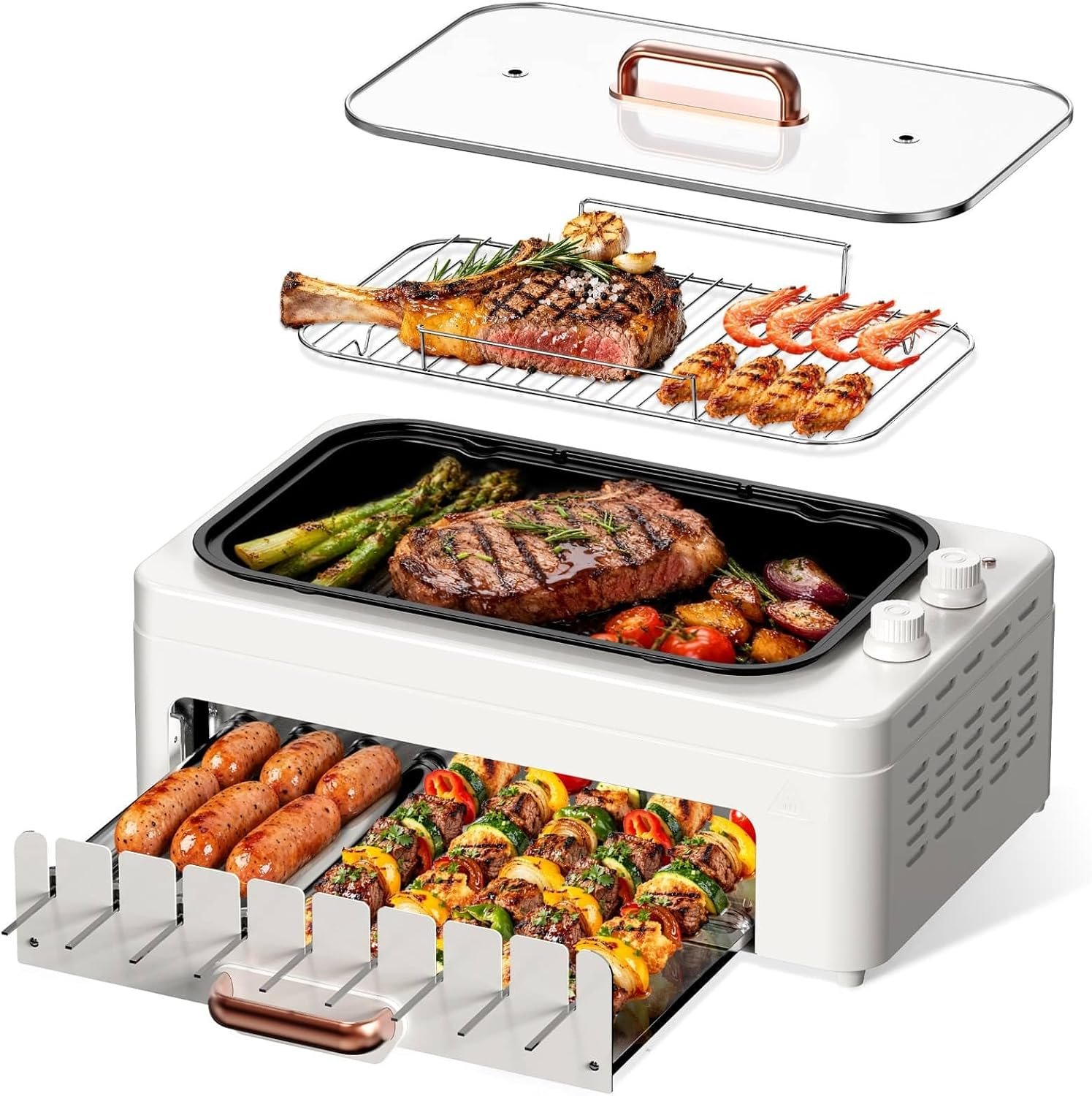
Selecting the right indoor electric grill is a decision that affects flavor, convenience, and kitchen workflow. For apartment dwellers, dorm residents, and anyone constrained by space or outdoor access, an electric countertop grill promises controlled heat without open flames, simpler cleanup, and year-round use. The buyer must weigh cooking style—high-heat searing versus longer, gentler cooking—alongside fuel type preferences, as electric elements behave differently from gas, charcoal, or pellet systems. Performance expectations hinge on temperature range, heat source layout, and whether the unit supports multi-function cooking such as grilling, baking, rotisserie-style skewers, and rollers. Durability and materials influence lifespan, while removable parts and non-stick finishes shape maintenance time. The XHJ Q2 positions itself as a compact, multifunction indoor grill with 360° rotating components and dual cooking zones; evaluation should focus on how those features translate to even heating, precise temperature control between 210°F and 430°F, cooking capacity for small families, and practicality for regular indoor use.
Quick Overview
| Feature | Details |
|---|---|
| Grill type | Countertop electric multi-function grill (4-in-1) |
| Fuel type | Electric (120 V, 1500 watts) |
| Total cooking area | Not specified by manufacturer; unit footprint 12.8″ D x 18.7″ W |
| Temperature range | 210°F to 430°F (adjustable) |
| Materials and construction | Metal frame, non-stick baking pan, stainless steel drip tray, plastic handles |
| Control system | Manual thermostat knob with 3 power levels and 0–45 minute timer |
| Heating elements | Four carbon heating tubes (four main burners) |
| Best suited cooking styles | Grilling, baking, hot dog rolling, rotating skewers, searing and medium-heat roasting |
| Intended use cases | Indoor countertop cooking for families of 3–5 people, apartments, dorms |
| Warranty | Not specified by manufacturer |
This feature set positions the Q2 as a compact, versatile indoor grill for cooks who need multi-function capability without outdoor infrastructure. The electric 1500 W design provides predictable, controllable heat for quicker start-up than charcoal and without combustion byproducts, while removable non-stick components and a drip tray simplify cleanup when used frequently in small kitchens.

Temperature control and cooking precision
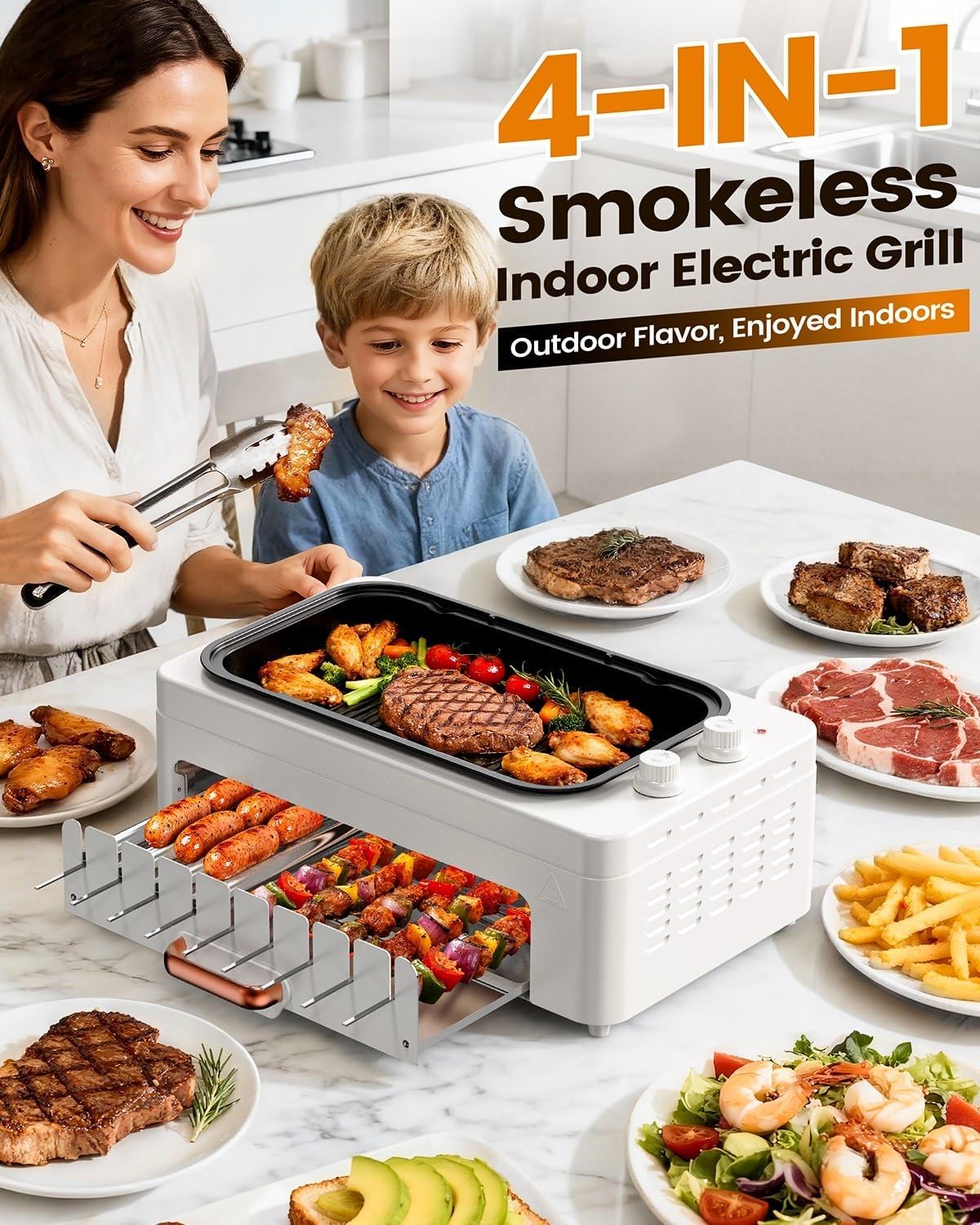
Precise temperature control is central to matching cooking technique to ingredient needs; the Q2 offers an adjustable range from 210°F to 430°F and a manual thermostat knob with three power levels plus a 0–45 minute timer. This range spans low-medium temperatures for gentle cooking and higher settings for searing; however, the manual knob and stepped power levels imply less granular control than digital PID systems. Electric carbon heating tubes deliver rapid heat-up and predictable temperature behavior, but consistency across the cooking surface depends on element placement and the dual-zone design. Buyers prioritizing exact low-and-slow smoking analogs or sous-vide–level consistency should expect typical electric limitations, while those seeking convenient, repeatable grilling and quick searing will find the temperature span appropriate for most everyday indoor cooking.
Temperature range versus practical outcomes
The 210°F to 430°F span covers common indoor grilling tasks: low-temperature finishing, moderate roasting, and high-heat searing. A maximum of 430°F is sufficient for achieving surface browning and grill marks on steaks and vegetables, though it falls short of the extreme searing temperatures achievable with gas or charcoal at true open-flame grills. The lower end at 210°F works for gentle cooking and some smoking-mimicry when used with moisture-control techniques, but the absence of a closed-chamber smoke source limits passive smoke infusion. Because control is manual and the unit uses stepped power levels, temperature stabilization will rely on the grill’s thermal mass and element cycling; users should anticipate some short-term fluctuation during frequent lid openings or heavy loads.
Control interface and timer implications
The manual thermostat knob plus 0–45 minute mechanical timer simplifies operation for routine tasks but restricts precision compared with digital controls that allow exact set points and hold temperatures. Three power levels can be useful for common presets—low, medium, high—but they do not substitute for proportional control when maintaining narrow temperature bands. The inclusion of a timer provides convenience for timed batches and avoids constant monitoring; nonetheless, for recipes that require long unattended holds or slow smoke-equivalent cooking, the lack of a dedicated low-temperature hold function means monitoring or periodic adjustment may be necessary.
Suitability for searing versus low-and-slow techniques
The Q2’s top-end temperature and concentrated carbon heating tubes favor searing and high-heat grilling for quick-cooking items, while the dual-zone layout supports gentler cooking on the lower zone for thicker cuts. For authentic low-and-slow barbecue or long smoke sessions, the electric system does not replicate wood-pellet or charcoal flavor development or the multi-hour thermal stability those fuels provide. However, for kitchen-focused users seeking a compact searing-capable unit with the option of slower roasting or heat-holding, the Q2’s temperature range and zoning provide useful versatility within the constraints of electric countertop operation.
Heat distribution, airflow, and element design
Heat distribution and airflow management determine how evenly food cooks and how effectively fats render without excessive smoking. The Q2 employs four carbon heating tubes spaced to create both an upper fast-cook zone and a lower slow-cook zone; a 360° auto-rotating system for rollers and skewers further mitigates hot spots by presenting food to the elements from multiple angles. The integrated lid and rectangular prism shape create a partial chamber that helps trap radiant heat, while the stainless steel drip tray and enlarged grease collection reduce direct contact of drippings with elements—minimizing smoke generation. Airflow in an indoor electric grill relies on passive vents and the lid geometry; the Q2’s design appears focused on limiting open convective paths to preserve heat in the slow-cook zone while permitting sufficient circulation for even browning in the fast zone.

Role of the 360° rotating system in even cooking
Automatic rotation exposes food to all elements over a cooking cycle, reducing the need to flip and helping achieve uniform surface color and internal doneness. For cylindrical or skewered items—hot dogs, kebabs, and vegetables—consistent rotation reduces localized charring and evens moisture loss. Mechanically, rotation compensates for element non-uniformity by averaging exposure, but it does not replace uniform element wattage or balanced spacing; the combo of rotation and dual-zone elements provides practical heat evenness advantages in countertop form factors where element count and spacing are constrained by size.
Drip management and smoke reduction
An enlarged stainless steel drip tray and removable grease-collection design are aimed at reducing flare-ups and smoke production typical of drippings on high-heat elements. By catching fats and food particles, the tray separates combustibles from the carbon tubes; for indoor use, this containment is critical to minimize odor and smoke that would otherwise accumulate. Non-stick surfaces on the baking pan and removable components further limit residue build-up, but routine cleaning is necessary to prevent grease aging and smoking during repeated high-heat sessions.
Airflow, lid design, and chamber behavior
The Q2’s removable lid and rectangular prism body create a semi-enclosed cooking chamber that increases radiant heat retention compared to open grills. Restricted venting preserves the temperature differential between the upper fast-cook zone and the lower slow-cook zone, enabling more controlled rendering of fats and plateaus in cooking curves. However, limited forced airflow means moisture evaporation and convective transfer are slower than on outdoor grills with active vents; cooks should account for longer carryover and adjust timing when converting outdoor recipes for indoor electric conditions.
Cooking capacity, multi-function versatility, and meal planning
Capacity and versatility often decide whether a countertop appliance fits household needs. The Q2’s footprint (12.8″ D x 18.7″ W) and inclusion of an upper rack, removable grill pan, grilling net, nine metal skewers, and four hot dog rollers indicate a design targeted at families of roughly three to five people, or social gatherings with small plates. The dual-zone configuration enables simultaneous high-heat and low-heat tasks—searing steaks on the upper zone while gently roasting vegetables below—while rotating skewers and rollers allow continuous, hands-free cooking of multiple items. Multi-function units excel at variety: grilling, baking, and roller-based foods are supported, but total simultaneous capacity depends on food size and arrangement; large roasts or wide cuts may require staging or single-zone use.

Practical serving capacity and surface limitations
Manufacturer dimensions suggest a compact cooking surface rather than an expanded full-size grill. While the exact total cooking area is not specified, the mix of grill rack, pan, and rollers supports portioned cooking for small groups rather than high-volume grilling. For consumers who frequently cook large briskets, full racks, or party-scale batches, the Q2 may necessitate staggered cooking. For everyday family meals, mixed plates, or entertaining with smaller items (kebabs, hot dogs, fish), the multi-component configuration facilitates efficient use of space and staggered workflows.
Multi-function component workflow
Removable pans, rollers, and skewers create flexible workflows: use the hot dog rollers for continuous rolling items, the skewers for kebabs requiring rotation, and the grill pan for searing or baking. Switching between modes is simplified by removable parts, but simultaneous use of all functions may be constrained by internal geometry. The preserved multi-mode capability is valuable for hosts who want to offer a variety of textures and formats without multiple appliances, though planning and staging remain important when preparing mixed menus.
Rotating rollers and skewer throughput
The four hot dog rollers and the set of nine metal skewers permit continuous rotation for many individual items; this supports even browning and reduces monitoring. Rollers are particularly effective for uniform sausages and small cylindrical items; skewers are better for mixed pieces where spacing and orientation vary. Mechanically, the auto-rotate feature trades manual turning for motor reliability concerns over time; longevity of the rotation motor and ease of replacement are considerations when assessing long-term throughput for frequent entertainers.
Materials, maintenance, and durability expectations
Materials and construction determine corrosion resistance, heat tolerance, and cleaning ease. The Q2 combines a metal frame with non-stick surfaces, stainless steel drip tray, plastic cool-touch handles, and carbon heating tubes. Non-stick finishes speed cleaning but can degrade over time under aggressive scrubbing or high-heat use; stainless steel trays resist corrosion from fats and cleaners but require routine emptying to prevent buildup. The removable design simplifies maintenance; all cooking components are intended to detach for cleaning. Durability hinges on the resilience of the non-stick coating, the robustness of the motorized rotation assembly, and the integrity of heating elements under cyclic thermal stress. Electrical components and motorized parts determine repairability and expected lifespan compared to simpler, passive grills.

Non-stick coatings and long-term wear
Non-stick baking pans and grill surfaces reduce food adherence and cleaning time, but coatings vary in longevity depending on quality and care. Repeated exposure to the high end of the temperature range (near 430°F) can accelerate coating wear if abrasive cleaning or metal utensils are used. Replacement availability for plates and pans affects long-term value; units with standardized or easily sourced components extend usable life. Buyers should expect routine re-seasoning and gentle cleaning to preserve coatings and avoid scratching.
Motor and mechanical component reliability
The 360° rotating motor and roller drive are mechanical subsystems that face torque and wear stresses, particularly with frequent heavy loads. Durable motors with sealed housings and straightforward access for service are preferable; however, units with integrated motor assemblies and non-serviceable housings may be limited in repair options. The Q2’s removable metal components ease cleaning, but motor maintenance and potential belt or gear wear are factors in projected lifespan and should be considered by frequent-users or small-scale hosts.
Ease of cleaning and day-to-day upkeep
Design choices that prioritize removable trays, non-stick pans, and dishwasher-safe components reduce time spent on cleaning and help maintain indoor air quality by removing grease that can otherwise cause smoking or odors. The stainless steel drip tray and enlarged grease-collection area are beneficial for frequent indoor use, lowering the risk of lingering smells. Regular emptying of the drip tray, wiping of non-stick surfaces, and inspection of heating elements for residue will preserve performance and minimize smoke during high-heat cooking sessions.

Pros & Cons
Pros
- Versatile 4-in-1 functionality: The integrated grill pan, grilling net, rotating skewers, and hot dog rollers enable a wide range of cooking styles from searing to baking and kabobs; this flexibility helps consolidate multiple appliances into a single countertop unit.
- Dual-zone cooking design: Upper fast-cook and lower slow-cook zones permit simultaneous high-heat searing and gentler heat holding, supporting mixed menus and more controlled fat rendering.
- Broad temperature range: Adjustable from 210°F to 430°F, the unit covers common indoor grilling needs including browning, roasting, and some searing tasks, making it adaptable to many recipes.
- 360° auto-rotation: Rotating rollers and skewers promote even exposure to heat and reduce manual flipping, which is advantageous for uniform doneness on cylindrical and skewer items.
- Removable and easy-clean components: Non-stick pan, stainless drip tray, and detachable rollers simplify cleanup and maintenance for indoor use.
- Compact countertop footprint: With a 12.8″ D x 18.7″ W footprint and free-standing installation, the grill suits apartments and kitchens with limited space.
Cons
- Limited maximum heat compared with outdoor fuels: A top-end of 430°F is effective for indoor searing but does not match the extreme surface temperatures achievable with charcoal or gas, which may affect crust development on thicker steaks.
- Manual control interface: The knob-based thermostat with three power levels provides less precise temperature holding than digital PID controllers, which can matter for delicate low-temperature tasks.
- Component longevity concerns: Non-stick surfaces and motorized rotation assemblies can wear over time; replacement parts and motor serviceability are not specified and may limit long-term repair options.
- Restricted total cooking area: The manufacturer does not specify total cooking surface; the compact footprint suggests limited capacity for very large cuts or party-scale batches, necessitating staged cooking for larger gatherings.
Final Verdict: Who This Grill or Smoker Is Best For (and Who Should Skip It)
The XHJ Q2 is best suited for home cooks who need a compact, multi-function indoor grill that balances searing capability with convenience. Its 4-in-1 design—grill pan, grate, rotating skewers, and hot dog rollers—fits households that prepare varied small-to-medium meals and seek hands-off rotation for kebabs, sausages, and portioned items. The 210°F to 430°F range and dual-zone layout support both quick high-heat tasks and gentler cooking, making it a strong option for apartment occupants, dorm residents, or countertop-focused cooks who prioritize versatility and easy cleanup.
This unit should be avoided by buyers who require high-volume cooking for large gatherings, those who want authentic charcoal or pellet smoke flavor profiles, or cooks demanding the tightest digital temperature control for prolonged low-temperature smoking. Compared with outdoor grills and larger indoor units available in 2026, the Q2 trades maximum searing peak and total capacity for multi-mode functionality and indoor-friendly design, delivering a practical balance for small households and versatile kitchen workflows.

Frequently Asked Questions (FAQs)
Can the XHJ Q2 electric indoor grill reach temperatures needed for searing steaks?
The XHJ Q2 offers an adjustable temperature range up to 430°F, which is sufficient for indoor searing and achieving surface browning and grill marks on steaks and vegetables. While it does not reach the extreme surface temperatures of some outdoor charcoal or gas grills, the combination of concentrated carbon heating tubes and direct radiant heat is designed to deliver meaningful searing performance for typical home-cooked cuts.
Is the Q2 suitable for low-and-slow smoking or long unattended cooks?
As an electric countertop unit, the Q2 supports gentler cooking within its 210°F lower range and a slow-cook zone, but it does not replicate wood-pellet or charcoal smoke infusion or the prolonged thermal stability those systems provide. For extended low-and-slow barbecue-style smoking, users should expect limitations in smoke flavor and may consider supplemental smoking methods or different fuel-based smokers for multi-hour sessions.
How does the 360° rotating system affect cooking results?
Automatic rotation presents food to the heating elements from all angles, averaging heat exposure and reducing localized charring. For cylindrical items and skewers, rotation enhances even browning and lessens the need for manual turning. The system improves uniformity but does not eliminate the influence of element spacing or thermal hotspots; load distribution and component arrangement still affect final results.
What cleaning and maintenance are required to keep the grill smokeless?
Routine cleaning of the stainless steel drip tray, non-stick baking pan, and removable rollers is essential to minimize grease accumulation that can cause smoke. Emptying the enlarged grease tray after each use, wiping non-stick surfaces with non-abrasive tools, and inspecting heating elements for residue will help preserve smokeless operation. Regular maintenance of the motor area and avoiding metal utensils on coated surfaces extend component life.
How many people can the Q2 realistically serve in one cooking cycle?
The Q2’s footprint and included accessories indicate capacity for small family meals—typically serving three to five people depending on portion sizes and food types. Exact simultaneous capacity is limited by internal layout and component arrangement; large cuts or party-scale batches will likely require staged cooking or multiple cycles.
Are replacement parts and service options readily available for motor or heating components?
Manufacturer disclosures do not specify replacement-part availability or warranty details. Mechanical components such as the rotating motor and heating tubes are potential wear items; buyers interested in long-term serviceability should verify part availability and local repair options before purchase, and follow routine care recommendations to reduce mechanical stress.
Does the Q2 produce indoor smoke and odors during high-heat cooking?
The Q2 includes an enlarged drip tray and removable grease-collection features designed to minimize drippings contacting hot elements, which reduces smoke and odors. However, any high-heat grilling can generate some odor; consistent cleaning of the drip tray and avoidance of excessive fat pooling will limit smoke production and help maintain acceptable indoor air quality.